
Domain-Aware Hierarchical Contrastive Learning for Semi-Supervised Generalization Fault Diagnosis
arXiv cs.LG / 4/24/2026
💬 OpinionIdeas & Deep AnalysisModels & Research
Key Points
- The paper studies semi-supervised domain generalization fault diagnosis (SSDGFD) for cases where target operating conditions are unseen and labeled data are scarce.
- It identifies two key shortcomings in prior work: pseudo-labels for unlabeled domains suffer from systematic cross-domain bias due to ignored domain-specific geometric differences, and unlabeled samples are often filtered with rigid accept-or-discard thresholds that can waste data and add noise.
- The authors propose a unified framework, domain-aware hierarchical contrastive learning (DAHCL), which adds a domain-aware learning (DAL) module to learn source-domain geometric characteristics and calibrate pseudo-label predictions across heterogeneous sources.
- DAHCL also introduces a hierarchical contrastive learning (HCL) module that uses dynamic confidence stratification and fuzzy contrastive supervision so uncertain samples can still improve representation learning without relying on unreliable hard labels.
- Experiments on three benchmark datasets (with engineering noise incorporated into the evaluation) show the approach improves supervision quality and better utilizes unlabeled data compared with existing SSDGFD methods.
Continue reading this article on the original site.
Read original →Related Articles
The 67th Attempt: When Your "Knowledge Management" System Becomes a Self-Fulfilling Prophecy of Excellence
Dev.to
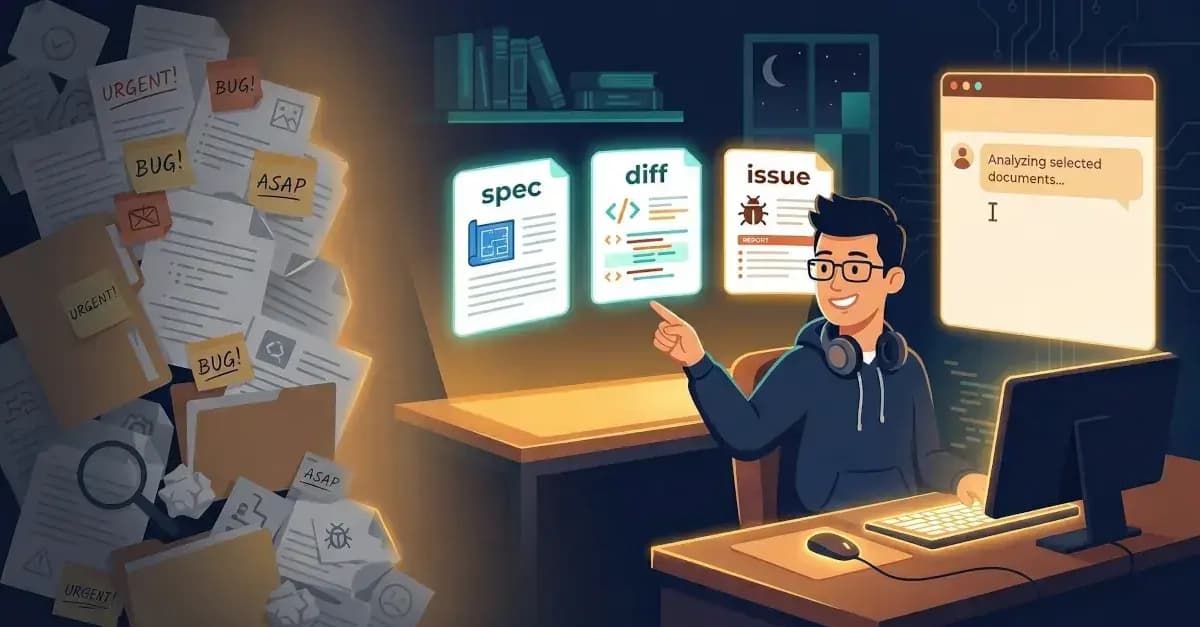
Context Engineering for Developers: A Practical Guide (2026)
Dev.to
GPT-5.5 is here. So is DeepSeek V4. And honestly, I am tired of version numbers.
Dev.to
I Built an AI Image Workflow with GPT Image 2.0 (+ Fixing Its Biggest Flaw)
Dev.to
Max-and-Omnis/Nemotron-3-Super-64B-A12B-Math-REAP-GGUF
Reddit r/LocalLLaMA


