
Scaling Whole-Body Human Musculoskeletal Behavior Emulation for Specificity and Diversity
arXiv cs.RO / 4/1/2026
💬 OpinionIdeas & Deep AnalysisModels & Research
Key Points
- The paper addresses how to emulate whole-body human musculoskeletal behavior for embodied learning, despite the inaccessibility of internal muscle-driven dynamics to direct measurement.
- It introduces the MS-Emulator framework, combining large-scale parallel GPU musculoskeletal simulation with adversarial reward aggregation and value-guided flow exploration to improve high-dimensional reinforcement-learning tracking.
- The method targets the shortcomings of prior inverse-dynamics and deep-RL imitation approaches, which struggled with redundancy resolution and the curse of dimensionality in control and reward design.
- MS-Emulator reproduces a diverse set of highly dynamic motions using a whole-body human model actuated by ~700 muscles, achieving high joint-angle accuracy and body-position alignment on tasks like dance, cartwheel, and backflip.
- The framework also reveals that multiple distinct internal musculoskeletal control policies can yield nearly identical external kinematics and mechanical measurements, supporting analysis of specificity versus diversity in human embodied control.
Related Articles

Show HN: 1-Bit Bonsai, the First Commercially Viable 1-Bit LLMs
Dev.to
I Built an AI Agent That Can Write Its Own Tools When It Gets Stuck
Dev.to

Agent Self-Discovery: How AI Agents Find Their Own Wallets
Dev.to
[P] Federated Adversarial Learning
Reddit r/MachineLearning
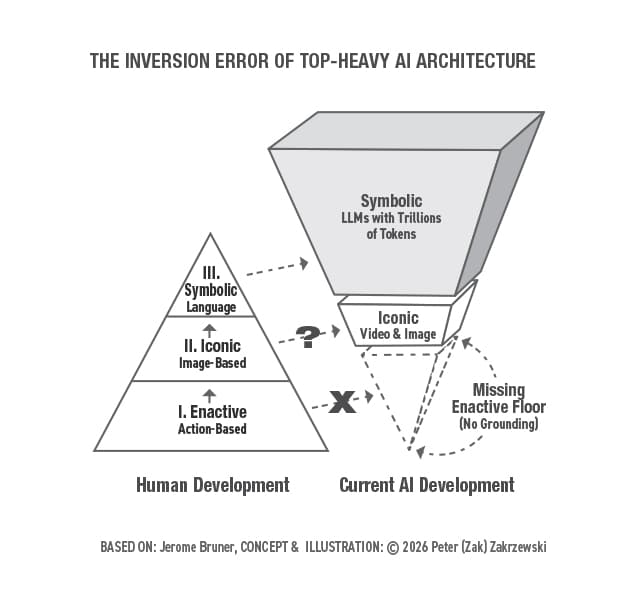
The Inversion Error: Why Safe AGI Requires an Enactive Floor and State-Space Reversibility
Towards Data Science


