
COTTA: Context-Aware Transfer Adaptation for Trajectory Prediction in Autonomous Driving
arXiv cs.CV / 4/2/2026
📰 NewsSignals & Early TrendsIdeas & Deep AnalysisModels & Research
Key Points
- The paper tackles a key autonomous-driving issue: trajectory prediction models trained on Western datasets often degrade when deployed in other geographic regions due to domain discrepancies.
- It evaluates transfer learning approaches for Query-Centric Trajectory Prediction (QCNet) moving from U.S. data to Korean driving scenarios, using a Korean dataset for experiments.
- Four strategies are compared—zero-shot transfer, training from scratch, full fine-tuning, and encoder freezing—to understand the best adaptation method.
- Results show that using pretrained knowledge substantially improves performance, with selectively fine-tuning the decoder while freezing the encoder achieving the best accuracy–efficiency trade-off.
- The proposed approach reduces prediction error by more than 66% compared with training from scratch and offers actionable guidance for deploying trajectory prediction systems in new domains.
Related Articles

Black Hat Asia
AI Business
v5.5.0
Transformers(HuggingFace)Releases
Bonsai (PrismML's 1 bit version of Qwen3 8B 4B 1.7B) was not an aprils fools joke
Reddit r/LocalLLaMA

Big Tech firms are accelerating AI investments and integration, while regulators and companies focus on safety and responsible adoption.
Dev.to
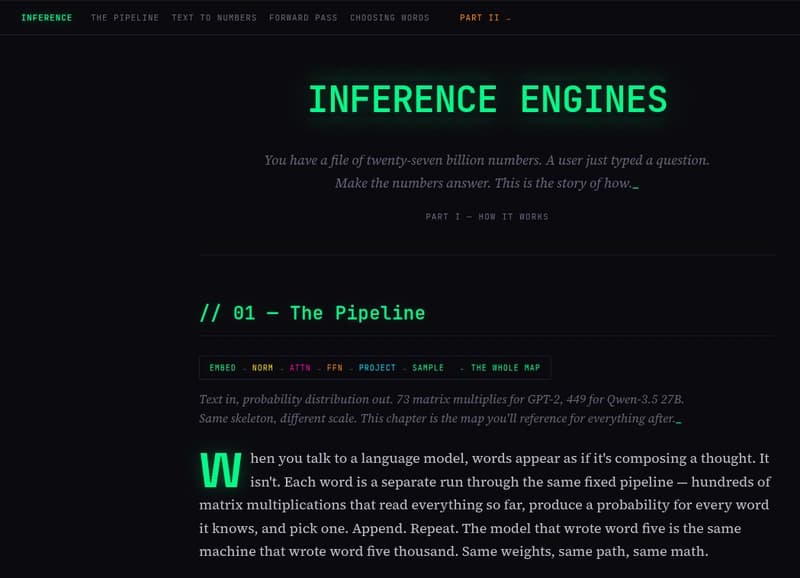
Inference Engines - A visual deep dive into the layers of an LLM
Dev.to


