
Perspective: Towards sustainable exploration of chemical spaces with machine learning
arXiv cs.AI / 4/2/2026
💬 OpinionIdeas & Deep AnalysisModels & Research
Key Points
- The Perspective argues that AI is accelerating molecular and materials discovery but introduces major sustainability concerns due to rising energy, compute, and infrastructure demands across the discovery pipeline.
- It analyzes resource costs from quantum-mechanical data generation and model training through automated “self-driving” research workflows, noting that large quantum datasets improve benchmarking while also increasing environmental and operational burdens.
- The article highlights efficiency strategies such as general-purpose ML models, multi-fidelity methods, model distillation, and active learning to reduce unnecessary computation.
- It recommends hierarchical workflows that apply fast ML surrogate models broadly and reserve high-accuracy QM calculations for targeted cases, while embedding physics-based constraints to maintain reliability.
- It emphasizes bridging computational predictions to real-world feasibility via synthesizability and multi-objective criteria, and calls for sustainable progress through open datasets/models and reusable, domain-specific workflows that maximize scientific value per unit of compute.
Related Articles
v5.5.0
Transformers(HuggingFace)Releases
Bonsai (PrismML's 1 bit version of Qwen3 8B 4B 1.7B) was not an aprils fools joke
Reddit r/LocalLLaMA

Big Tech firms are accelerating AI investments and integration, while regulators and companies focus on safety and responsible adoption.
Dev.to
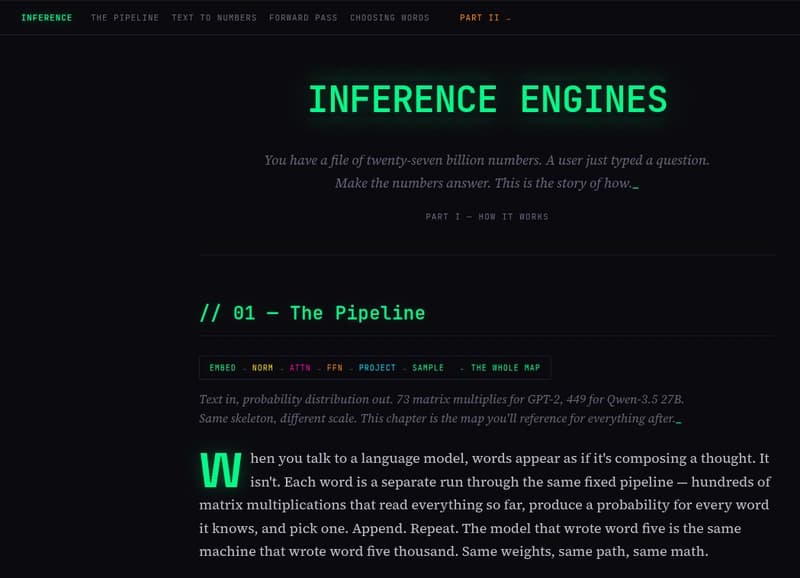
Inference Engines - A visual deep dive into the layers of an LLM
Dev.to
Surprised by how capable Qwen3.5 9B is in agentic flows (CodeMode)
Reddit r/LocalLLaMA


