
End-to-End Low-Level Neural Control of an Industrial-Grade 6D Magnetic Levitation System
arXiv cs.RO / 3/27/2026
💬 OpinionSignals & Early TrendsIdeas & Deep AnalysisModels & Research
Key Points
- The paper proposes an end-to-end neural controller for a 6D industrial-grade magnetic levitation system, directly converting raw sensor inputs and 6D reference poses into coil current commands.
- Instead of relying on hand-crafted control engineering, it learns from interaction data generated by a proprietary traditional controller, aiming to overcome conservative performance limits of conventional robust controllers.
- The resulting neural controller is reported to generalize to previously unseen scenarios while still achieving accurate and robust closed-loop control.
- The authors position this as the first neural controller for 6D magnetic levitation and argue it demonstrates practical feasibility for replacing or augmenting traditional control engineering in real-world complex physical systems.
- Public resources are provided, including trained controller materials, source code, and demonstration videos, to enable further research and replication.
広告
Related Articles
Got My 39-Agent System Audited Live. Here's What the Maturity Scorecard Revealed.
Dev.to
The Redline Economy
Dev.to
$500 GPU outperforms Claude Sonnet on coding benchmarks
Dev.to
From Scattershot to Sniper: AI for Hyper-Personalized Media Lists
Dev.to
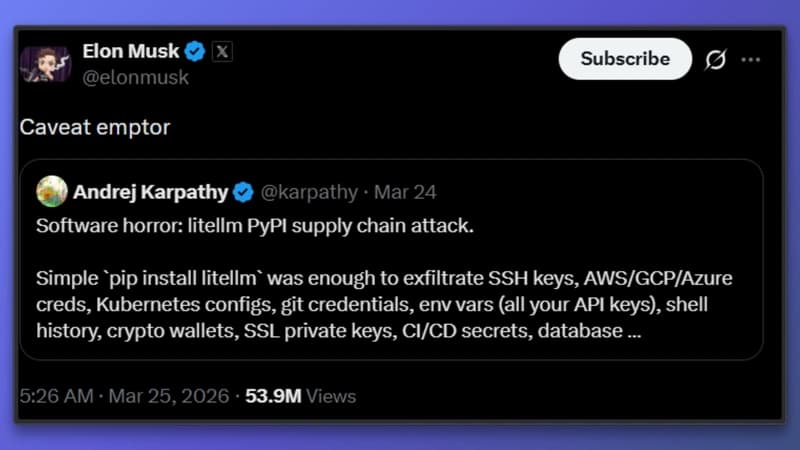
The LiteLLM Supply Chain Attack: A Wake-Up Call for AI Infrastructure
Dev.to


