
Calibration of the underlying surface parameters for urban flood using latent variables and adjoint equation
arXiv cs.LG / 5/6/2026
📰 NewsDeveloper Stack & InfrastructureModels & Research
Key Points
- The study presents a Bayesian maximum-likelihood formulation to calibrate key urban surface parameters needed for more accurate urban flood simulations.
- It uses an urban flood dynamical system as a surrogate model and introduces machine-learning-inspired latent variables to better represent uncertainties while remaining compatible with physical parameter calibration.
- To speed up optimization, the authors derive an adjoint equation for the surrogate model to efficiently obtain gradient information.
- They further reduce computational complexity by applying parameter sharing and localization techniques within the adjoint-based optimization.
- Experiments show fast convergence in a simple test case and demonstrate calibration results for Manning’s coefficient on urban roads in “Test 8A,” with relative errors ranging from 1.16% to 13.88%.
Related Articles

SIFS (SIFS Is Fast Search) - local code search for coding agents
Dev.to

BizNode's semantic memory (Qdrant) makes your bot smarter over time — it remembers past conversations and answers...
Dev.to
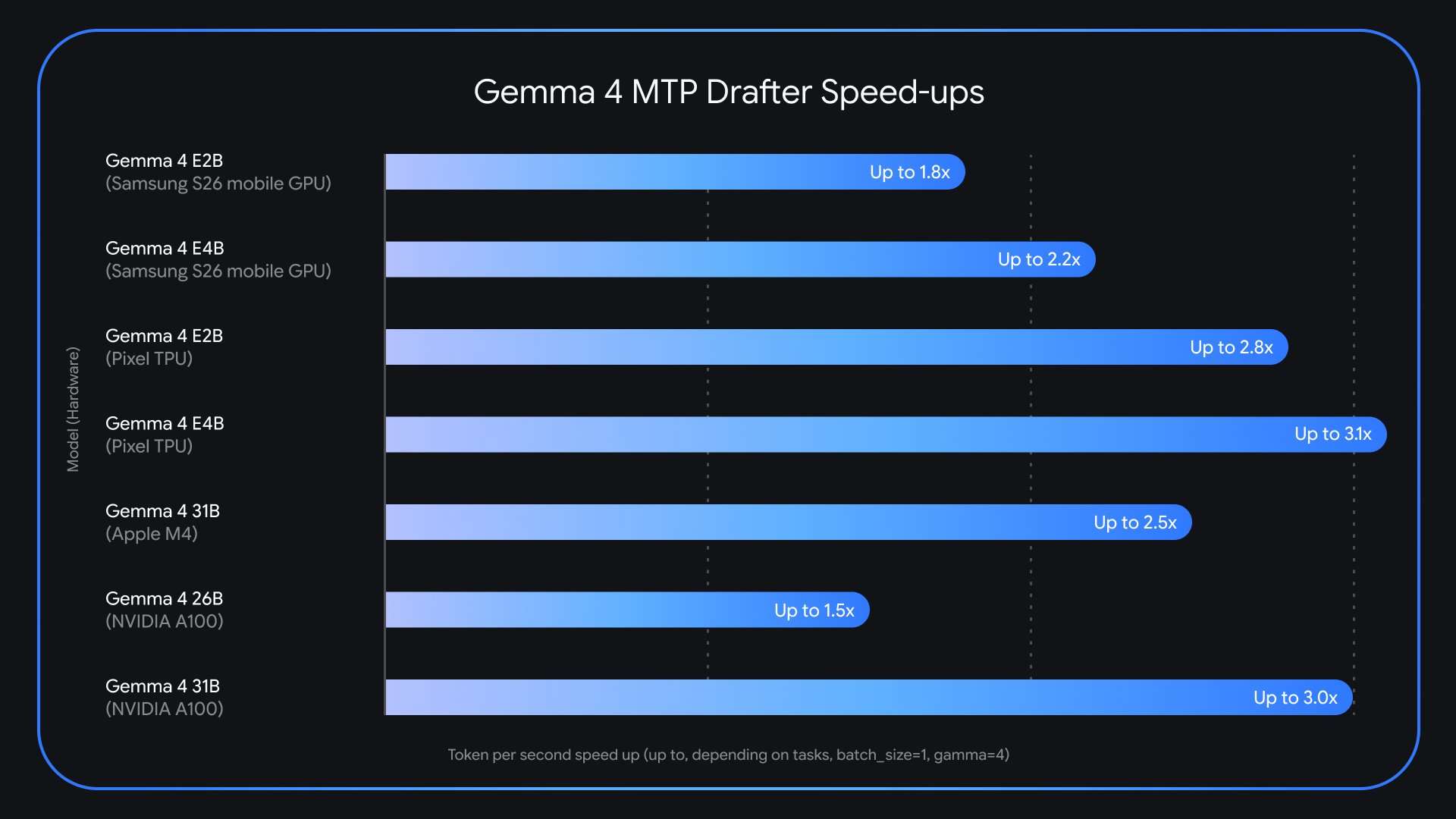
Google AI Releases Multi-Token Prediction (MTP) Drafters for Gemma 4: Delivering Up to 3x Faster Inference Without Quality Loss
MarkTechPost
Solidity LM surpasses Opus
Reddit r/LocalLLaMA

Quality comparison between Qwen 3.6 27B quantizations (BF16, Q8_0, Q6_K, Q5_K_XL, Q4_K_XL, IQ4_XS, IQ3_XXS,...)
Reddit r/LocalLLaMA


