
UCell: rethinking generalizability and scaling of bio-medical vision models
arXiv cs.CV / 4/2/2026
💬 OpinionSignals & Early TrendsIdeas & Deep AnalysisModels & Research
Key Points
- The paper argues that in biomedical vision tasks, scaling can be limited by scarce, costly training data, so focusing on smaller, more generalizable models may be more effective than building ever-larger foundation models.
- It introduces UCell, a 10–30M parameter biomedical segmentation model that uses a recursive forward computation structure to improve parameter efficiency.
- Experiments on multiple benchmarks show UCell matches the performance of models 10–20× larger for single-cell segmentation while maintaining similar out-of-domain generalizability.
- The authors report that UCell can be trained from scratch using only microscopy imaging data, avoiding reliance on large-scale pretraining on natural images.
- They further validate adaptability through extensive one-shot and few-shot fine-tuning experiments across many small datasets and provide implementation on GitHub.
Related Articles

Black Hat Asia
AI Business
v5.5.0
Transformers(HuggingFace)Releases
Bonsai (PrismML's 1 bit version of Qwen3 8B 4B 1.7B) was not an aprils fools joke
Reddit r/LocalLLaMA

Big Tech firms are accelerating AI investments and integration, while regulators and companies focus on safety and responsible adoption.
Dev.to
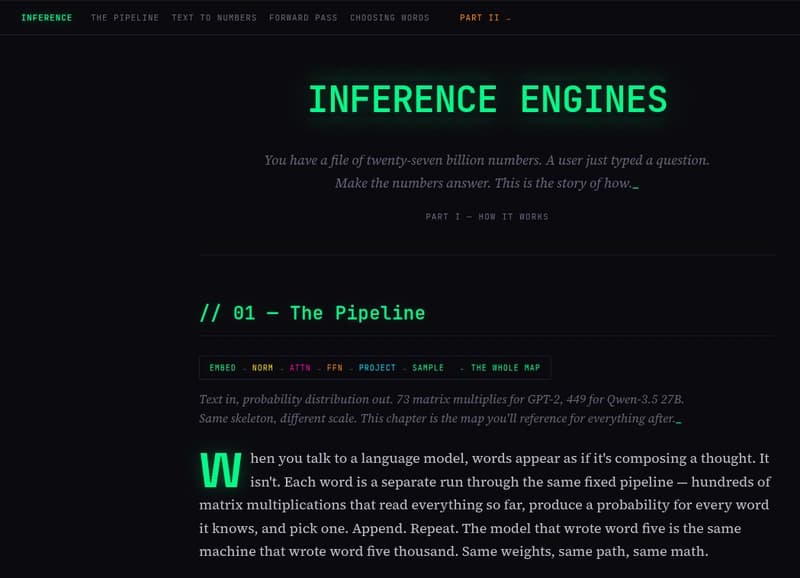
Inference Engines - A visual deep dive into the layers of an LLM
Dev.to


