
Captioning Daily Activity Images in Early Childhood Education: Benchmark and Algorithm
arXiv cs.CV / 4/3/2026
💬 OpinionSignals & Early TrendsIdeas & Deep AnalysisModels & Research
Key Points
- The paper addresses limitations in early childhood education (ECE) image captioning, focusing on the scarcity of domain-specific datasets and training methods that lead to generic descriptions or unstable optimization on hard samples.
- It introduces ECAC, a large-scale benchmark with 256,121 real-world ECE daily activity images, expert-level captions, and fine-grained labels, along with a domain-specific evaluation protocol (Teaching Toy Recognition Score, TTS) for professional object naming accuracy.
- To improve fine-grained recognition, it proposes RSRS, a hybrid training framework that conditionally switches between reinforcement learning and supervised fine-tuning to stabilize optimization and reduce “advantage collapse.”
- Using ECAC and RSRS, the authors develop KinderMM-Cap-3B, a domain-adapted multimodal LLM, reporting a TTS of 51.06 and improved caption quality over prior baselines, suggesting usefulness for specialized educational applications.
Related Articles

Black Hat Asia
AI Business

90000 Tech Workers Got Fired This Year and Everyone Is Blaming AI but Thats Not the Whole Story
Dev.to

Microsoft’s $10 Billion Japan Bet Shows the Next AI Battleground Is National Infrastructure
Dev.to
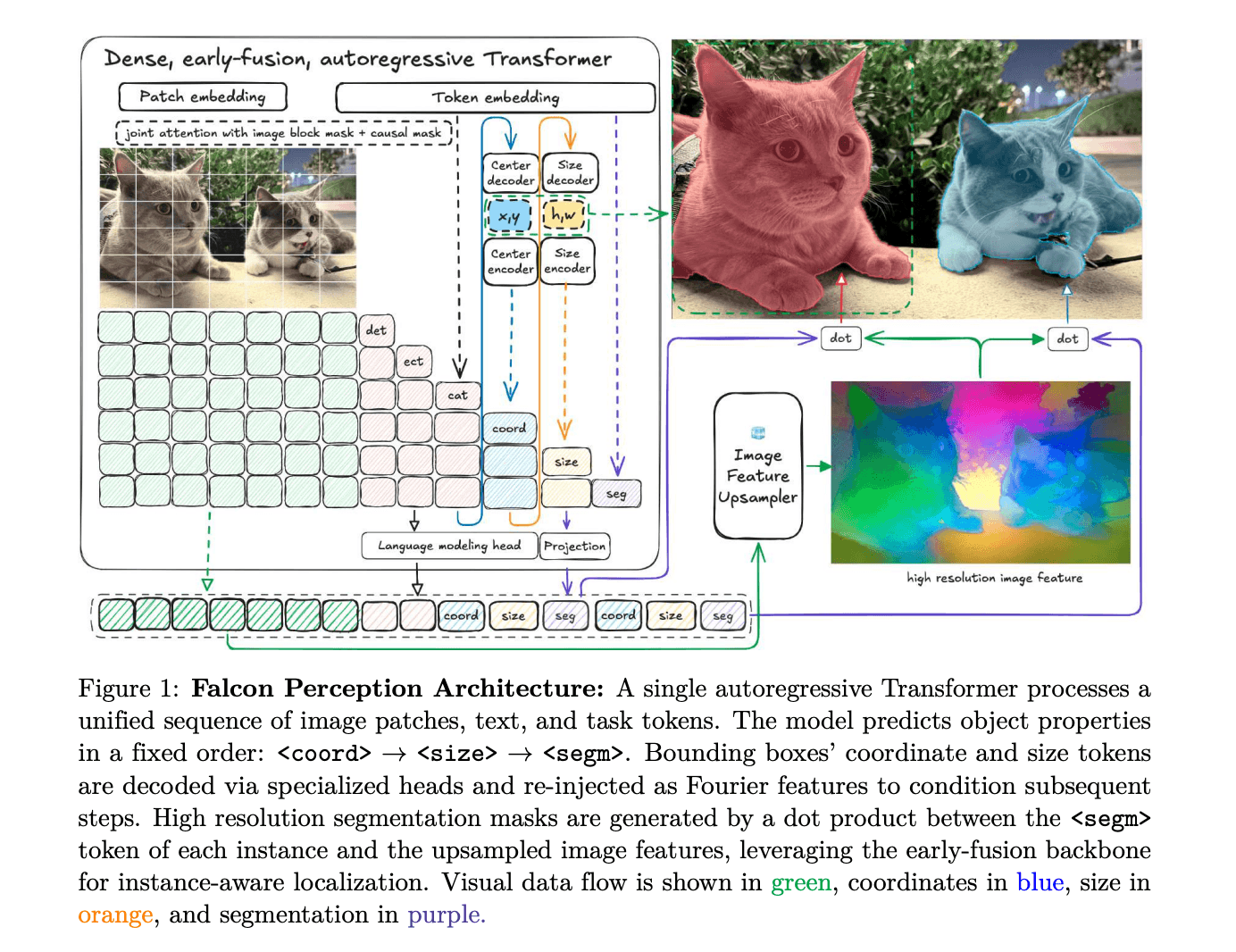
TII Releases Falcon Perception: A 0.6B-Parameter Early-Fusion Transformer for Open-Vocabulary Grounding and Segmentation from Natural Language Prompts
MarkTechPost

Portable eye scanner powered by AI expands access to low-cost community screening
Reddit r/artificial


