
Deep Learning-Accelerated Surrogate Optimization for High-Dimensional Well Control in Stress-Sensitive Reservoirs
arXiv cs.LG / 4/2/2026
💬 OpinionSignals & Early TrendsIdeas & Deep AnalysisModels & Research
Key Points
- The paper addresses production optimization in stress-sensitive unconventional reservoirs, where drawdown improves short-term output but accelerates permeability loss and harms long-term recovery, creating a nonlinear, time-varying control trade-off.
- It proposes a deep learning surrogate optimization framework that treats well control as a continuous, high-dimensional problem and uses problem-informed sampling to generate training data aligned with optimization trajectories.
- A neural network proxy is trained to approximate the relationship between bottomhole pressure trajectories and cumulative production, using outputs from fully coupled flow–geomechanics simulation.
- The surrogate is integrated into a constrained optimization loop, achieving 2–5% agreement with full-physics solutions across multiple initializations while reducing computation by up to three orders of magnitude.
- The authors note that main errors occur near the boundary of the training distribution and due to local optimization effects, and argue the approach generalizes to other PDE-constrained problems.
Related Articles

Black Hat Asia
AI Business
v5.5.0
Transformers(HuggingFace)Releases
Bonsai (PrismML's 1 bit version of Qwen3 8B 4B 1.7B) was not an aprils fools joke
Reddit r/LocalLLaMA

Big Tech firms are accelerating AI investments and integration, while regulators and companies focus on safety and responsible adoption.
Dev.to
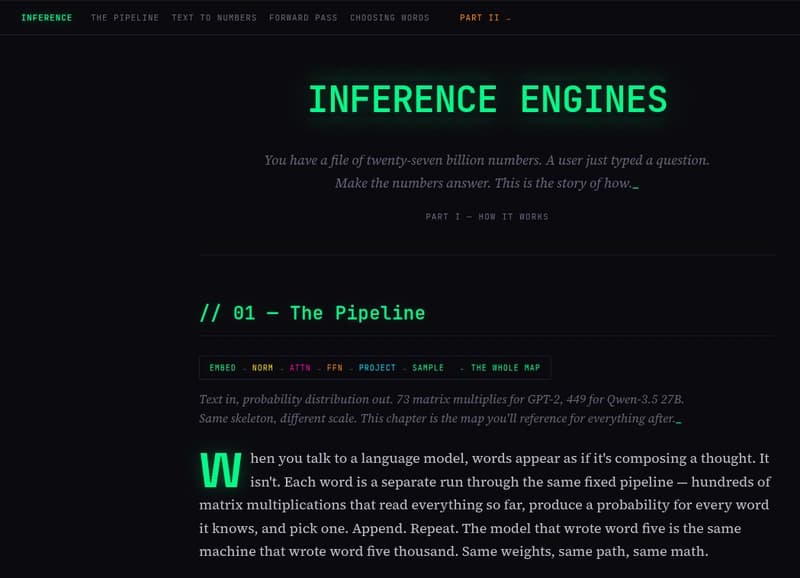
Inference Engines - A visual deep dive into the layers of an LLM
Dev.to


