
Gradient-flow SDEs have unique transient population dynamics
arXiv stat.ML / 4/2/2026
💬 OpinionIdeas & Deep AnalysisModels & Research
Key Points
- The paper addresses identifiability in stochastic differential equations by showing that, for gradient-flow SDEs, both drift and diffusion can be inferred from temporal marginals without assuming the diffusivity is known.
- It proves a necessary-and-sufficient condition for identifiability: joint recovery of drift and diffusion is possible if and only if the process is observed outside of equilibrium.
- Building on this theory, the authors introduce nn-APPEX, a Schrödinger Bridge–based inference method that learns drift and diffusion simultaneously from observed marginals.
- Experimental results indicate nn-APPEX mitigates bias seen in prior Schrödinger Bridge approaches, which relied on an assumed (and often incorrect) diffusion value.
- Overall, the work strengthens the theoretical foundations and practical inference of gradient-flow SDEs relevant to domains like machine learning and single-cell biology.
Related Articles
v5.5.0
Transformers(HuggingFace)Releases
Bonsai (PrismML's 1 bit version of Qwen3 8B 4B 1.7B) was not an aprils fools joke
Reddit r/LocalLLaMA

Big Tech firms are accelerating AI investments and integration, while regulators and companies focus on safety and responsible adoption.
Dev.to
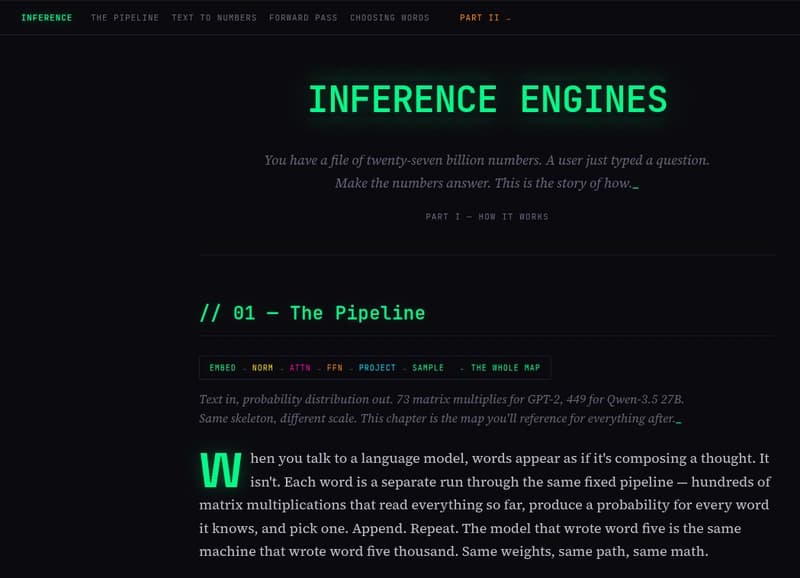
Inference Engines - A visual deep dive into the layers of an LLM
Dev.to
Surprised by how capable Qwen3.5 9B is in agentic flows (CodeMode)
Reddit r/LocalLLaMA


