
Model-Based Learning of Near-Optimal Finite-Window Policies in POMDPs
arXiv cs.LG / 4/2/2026
💬 OpinionIdeas & Deep AnalysisModels & Research
Key Points
- The paper studies how to learn finite-window policies for tabular POMDPs using a model-based approach that converts finite history windows into a “superstate MDP.”
- It argues that standard MDP planning becomes possible once a model of the superstate MDP is estimated, but emphasizes that collecting data from the original POMDP creates a sampling–target mismatch.
- The authors propose a model estimation procedure for tabular POMDPs and provide a sample-complexity analysis for estimating the superstate MDP model from a single trajectory.
- The analysis leverages a link between filter stability and concentration bounds for weakly dependent random variables to obtain tight guarantees.
- Using value iteration on the learned superstate model, the method produces approximately optimal finite-window policies for the original POMDP.
Related Articles
v5.5.0
Transformers(HuggingFace)Releases
Bonsai (PrismML's 1 bit version of Qwen3 8B 4B 1.7B) was not an aprils fools joke
Reddit r/LocalLLaMA

Big Tech firms are accelerating AI investments and integration, while regulators and companies focus on safety and responsible adoption.
Dev.to
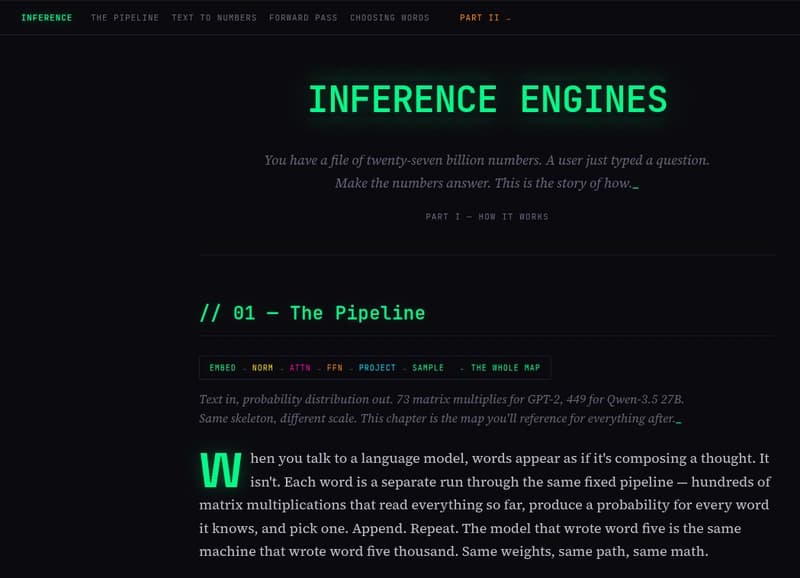
Inference Engines - A visual deep dive into the layers of an LLM
Dev.to
Surprised by how capable Qwen3.5 9B is in agentic flows (CodeMode)
Reddit r/LocalLLaMA


