
Behavioral Score Diffusion: Model-Free Trajectory Planning via Kernel-Based Score Estimation from Data
arXiv cs.RO / 4/2/2026
💬 OpinionIdeas & Deep AnalysisModels & Research
Key Points
- The paper introduces Behavioral Score Diffusion (BSD), a diffusion-based trajectory planner that is training-free and model-free by estimating the diffusion score directly from a pre-collected trajectory dataset.
- BSD performs multi-scale, kernel-weighted trajectory retrieval using three factors—diffusion proximity, state context, and goal relevance—and applies Nadaraya-Watson estimation at each denoising step to produce denoised trajectories.
- The diffusion noise schedule is used to control kernel bandwidths, yielding a coarse-to-fine regression behavior that captures global-to-local nonlinear dynamics without dynamics model linearization or parametric assumptions.
- Safety is maintained through shielded rollouts on the kernel-estimated state trajectories, using an approach aligned with existing model-based safety mechanisms.
- On four robotic parking tasks spanning 3D to 6D state spaces, BSD with fixed bandwidth reaches about 98.5% of a model-based baseline average reward using only 1,000 trajectories and significantly improves over nearest-neighbor retrieval, highlighting the importance of diffusion denoising.
Related Articles
v5.5.0
Transformers(HuggingFace)Releases
Bonsai (PrismML's 1 bit version of Qwen3 8B 4B 1.7B) was not an aprils fools joke
Reddit r/LocalLLaMA

Big Tech firms are accelerating AI investments and integration, while regulators and companies focus on safety and responsible adoption.
Dev.to
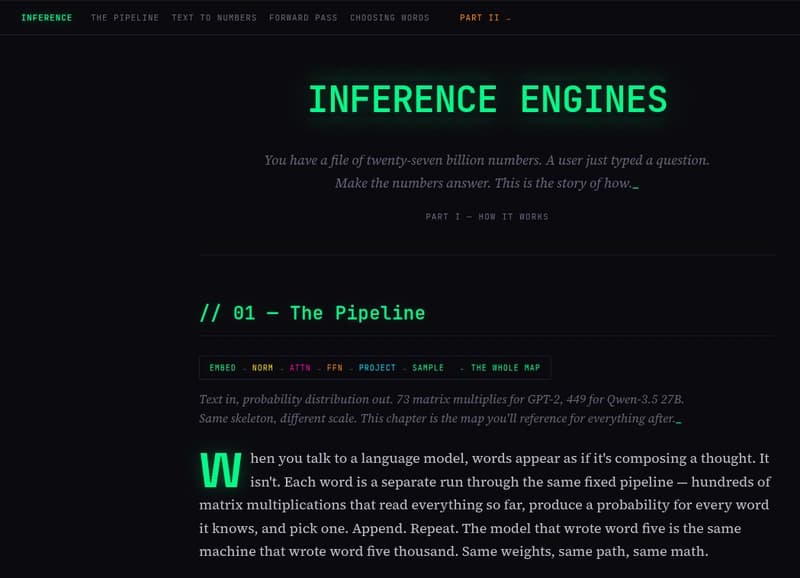
Inference Engines - A visual deep dive into the layers of an LLM
Dev.to
Surprised by how capable Qwen3.5 9B is in agentic flows (CodeMode)
Reddit r/LocalLLaMA


