
Focal plane wavefront control with model-based reinforcement learning
arXiv cs.RO / 4/2/2026
💬 OpinionSignals & Early TrendsIdeas & Deep AnalysisModels & Research
Key Points
- The paper addresses non-common-path aberrations (NCPAs) that limit high-contrast imaging for directly detecting potentially habitable exoplanets, where speckle noise and static aberrations degrade observations near bright host stars.
- It proposes a model-based reinforcement learning approach, Policy Optimization for NCPAs (PO4NCPA), which uses sequential phase diversity and focal-plane images to compute phase corrections without prior system knowledge.
- Through numerical simulations on a ground-based telescope and an infrared imager with water-vapor-induced seeing (dynamic NCPAs), PO4NCPA is shown to robustly compensate both static and dynamic NCPAs.
- In static scenarios, the method achieves near-optimal focal-plane light suppression with a coronagraph and near-optimal Strehl without one, and in dynamic scenarios it matches a reference technique’s performance metrics.
- The approach is demonstrated to generalize across ELT pupil configurations and a vector vortex coronagraph, remains effective under photon/background noise, and has sub-millisecond inference suitable for real-time low-order atmospheric correction.
Related Articles

Black Hat Asia
AI Business
v5.5.0
Transformers(HuggingFace)Releases
Bonsai (PrismML's 1 bit version of Qwen3 8B 4B 1.7B) was not an aprils fools joke
Reddit r/LocalLLaMA

Big Tech firms are accelerating AI investments and integration, while regulators and companies focus on safety and responsible adoption.
Dev.to
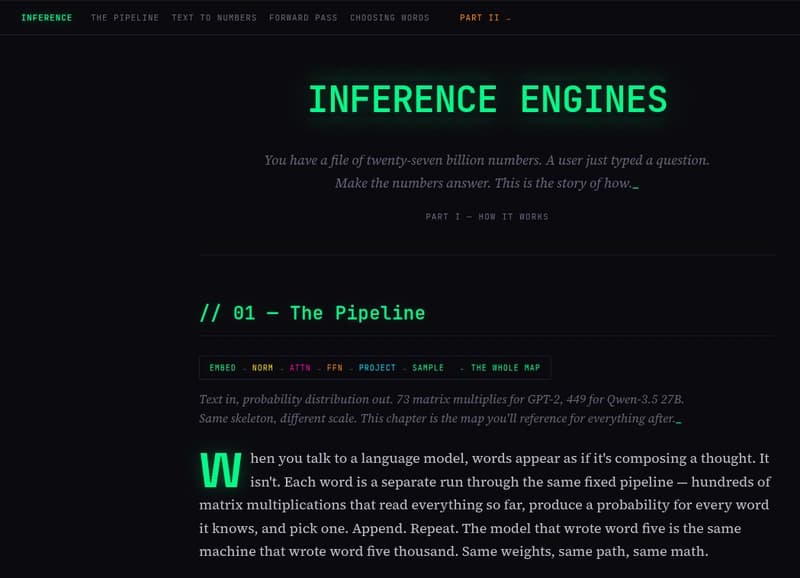
Inference Engines - A visual deep dive into the layers of an LLM
Dev.to


