
Meta-Inverse Physics-Informed Neural Networks for High-Dimensional Ordinary Differential Equations
arXiv cs.LG / 5/6/2026
📰 NewsModels & Research
Key Points
- The paper addresses inverse problems for high-dimensional coupled ODE dynamical systems under partial observability and sparse observations, a common challenge in scientific machine learning.
- It proposes a meta-inverse physics-informed neural network (MI-PINN) that reframes inverse modeling as a two-stage meta-learning task to improve optimization stability and generalization versus typical task-specific PINN joint optimization.
- MI-PINN learns a physics-aware representation across multiple tasks first, then performs inverse inference by optimizing only task-specific unknowns while freezing the shared representation to reduce the search space and boost sample efficiency.
- To better model multi-scale dynamics in such systems, the method adds an adaptive clustering-based multi-branch learning scheme.
- Experiments on complex whole-body PBPK models (up to 33 coupled ODEs) show MI-PINN can accurately recover masked kinetic parameters and reconstruct missing mechanistic terms for paracetamol and theophylline dosing scenarios.
Related Articles
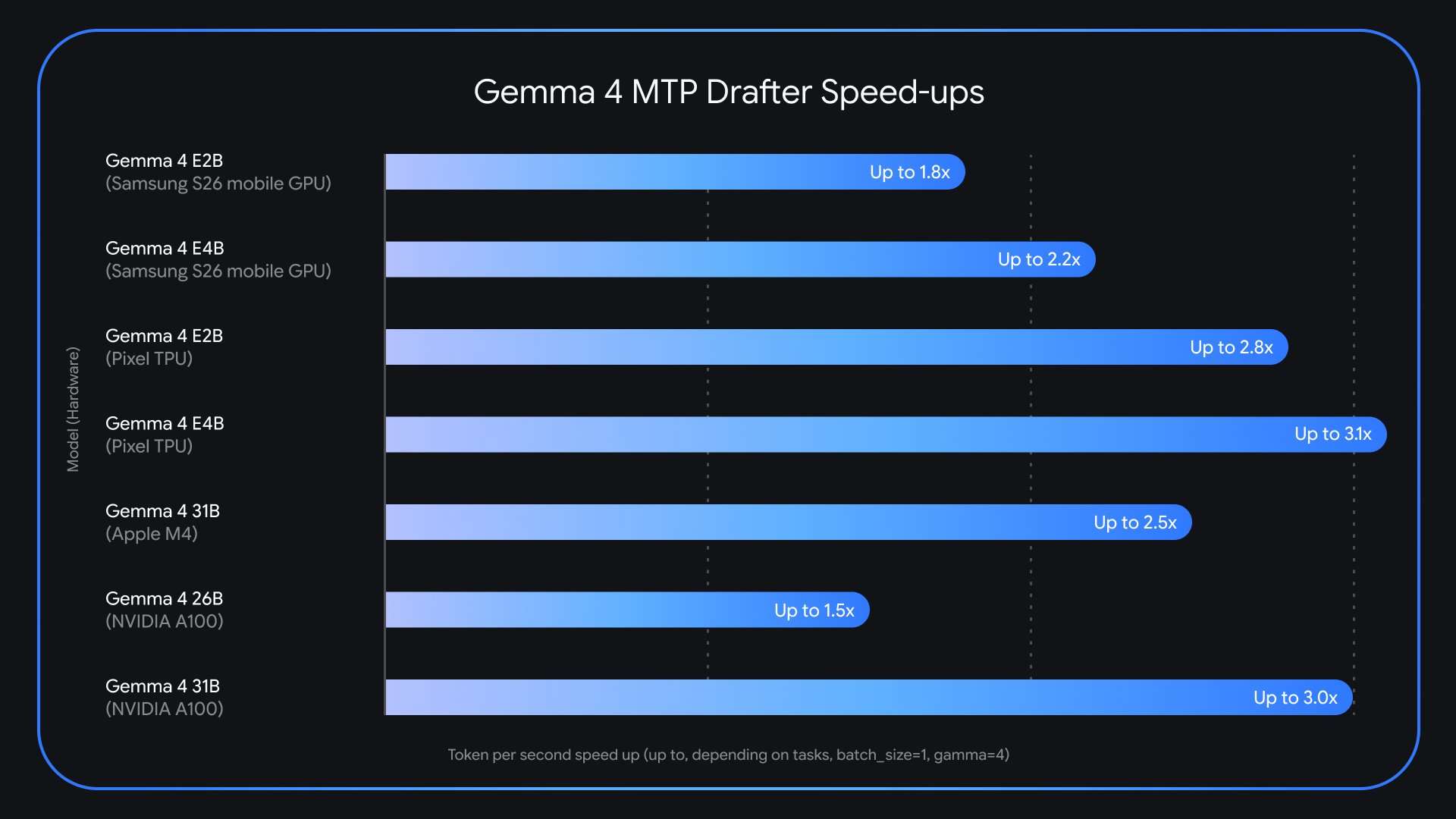
Google AI Releases Multi-Token Prediction (MTP) Drafters for Gemma 4: Delivering Up to 3x Faster Inference Without Quality Loss
MarkTechPost
Solidity LM surpasses Opus
Reddit r/LocalLLaMA

Quality comparison between Qwen 3.6 27B quantizations (BF16, Q8_0, Q6_K, Q5_K_XL, Q4_K_XL, IQ4_XS, IQ3_XXS,...)
Reddit r/LocalLLaMA

We measured the real cost of running a GPT-5.4 chatbot on live websites
Reddit r/artificial

AI ecosystems in China and US grow apart amid tech war
SCMP Tech


