
DLWM: Dual Latent World Models enable Holistic Gaussian-centric Pre-training in Autonomous Driving
arXiv cs.CV / 4/2/2026
📰 NewsSignals & Early TrendsIdeas & Deep AnalysisModels & Research
Key Points
- The paper proposes DLWM (Dual Latent World Models), a two-stage training paradigm aimed at holistic Gaussian-centric pre-training for vision-based autonomous driving.
- In stage one, DLWM learns to predict 3D semantic Gaussians from queries by self-supervised reconstruction of multi-view semantic and depth images to obtain fine-grained contextual features.
- In stage two, it trains two separate latent world models for temporal feature learning: one using Gaussian-flow-guided latent prediction for occupancy perception and 4D occupancy forecasting, and another using ego-planning-guided latent prediction for motion planning.
- Experiments on the SurroundOcc and nuScenes benchmarks show significant performance gains across Gaussian-centric 3D occupancy perception, 4D occupancy forecasting, and motion planning tasks.
Related Articles

Black Hat Asia
AI Business
v5.5.0
Transformers(HuggingFace)Releases
Bonsai (PrismML's 1 bit version of Qwen3 8B 4B 1.7B) was not an aprils fools joke
Reddit r/LocalLLaMA

Big Tech firms are accelerating AI investments and integration, while regulators and companies focus on safety and responsible adoption.
Dev.to
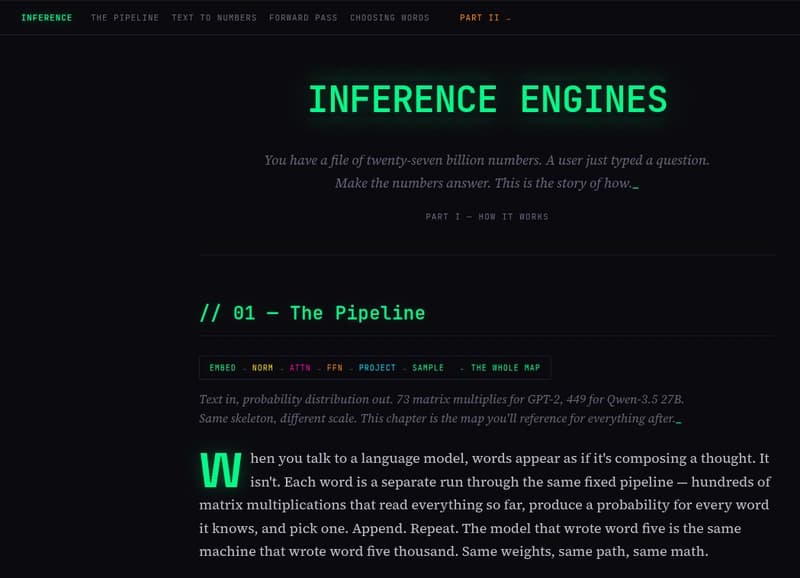
Inference Engines - A visual deep dive into the layers of an LLM
Dev.to


