
Quantifying Multimodal Capabilities: Formal Generalization Guarantees in Pairwise Metric Learning
arXiv cs.LG / 5/5/2026
📰 NewsIdeas & Deep AnalysisModels & Research
Key Points
- The paper provides a fine-grained theoretical study of generalization in multimodal metric learning, focusing on how missing or redundant modalities affect performance in real-world settings.
- It builds hierarchical function-class relationships across different modality subsets and quantifies discrepancies between learned mappings and the ground truth.
- The authors analyze pairwise complexity to derive new generalization error bounds, showing how both the number of modalities and their granularity jointly influence model performance.
- The results include matching upper and lower bounds, indicating that using more fine-grained modality features can reduce hypothesis-space complexity by improving modality complementarity.
- The work connects theory to practice by offering implications for faster convergence rates and higher accuracy in multimodal learning systems.
Related Articles

The 55.6% problem: why frontier LLMs fail at embedded code
Dev.to

Four CVEs in a week, all the same shape: when agents execute LLM-generated code
Dev.to
Healthcare AI Is Absorbing Institutional Knowledge It Can't Actually Hold
Reddit r/artificial
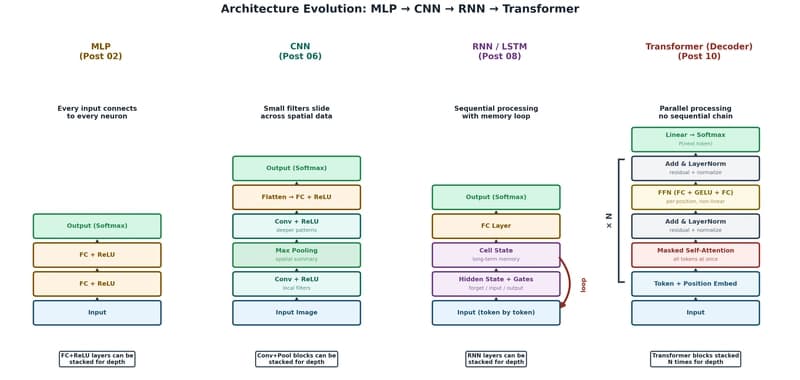
The Transformer: The Architecture Behind Modern AI
Dev.to

Foundational Models Defining a New Era in Vision: A Survey and Outlook
Dev.to


