
Amortized Variational Inference for Joint Posterior and Predictive Distributions in Bayesian Uncertainty Quantification
arXiv stat.ML / 5/6/2026
📰 NewsIdeas & Deep AnalysisModels & Research
Key Points
- The paper addresses the computational burden of the common two-stage Bayesian workflow that first approximates the parameter posterior and then propagates it to predictions via Monte Carlo sampling.
- It proposes a variational Bayesian method that directly learns the posterior-predictive distribution by jointly training variational approximations for both the posterior over parameters and the predictive distribution.
- The approach uses a variational upper bound on the KL divergence along with moment-based regularization terms to improve the quality of the learned distributions.
- By training the variational distributions in an amortized (offline-to-online) manner, the method moves computation offline and enables faster online predictive inference, particularly for expensive high-fidelity models (e.g., PDE-based).
- Experiments on analytical benchmarks and a finite-element solid mechanics case show improved predictive accuracy over conventional two-stage variational inference with a substantial reduction in online inference cost.
Related Articles

Top 10 Free AI Tools for Students in 2026: The Ultimate Study Guide
Dev.to

AI as Your Contingency Co-Pilot: Automating Wedding Day 'What-Ifs'
Dev.to
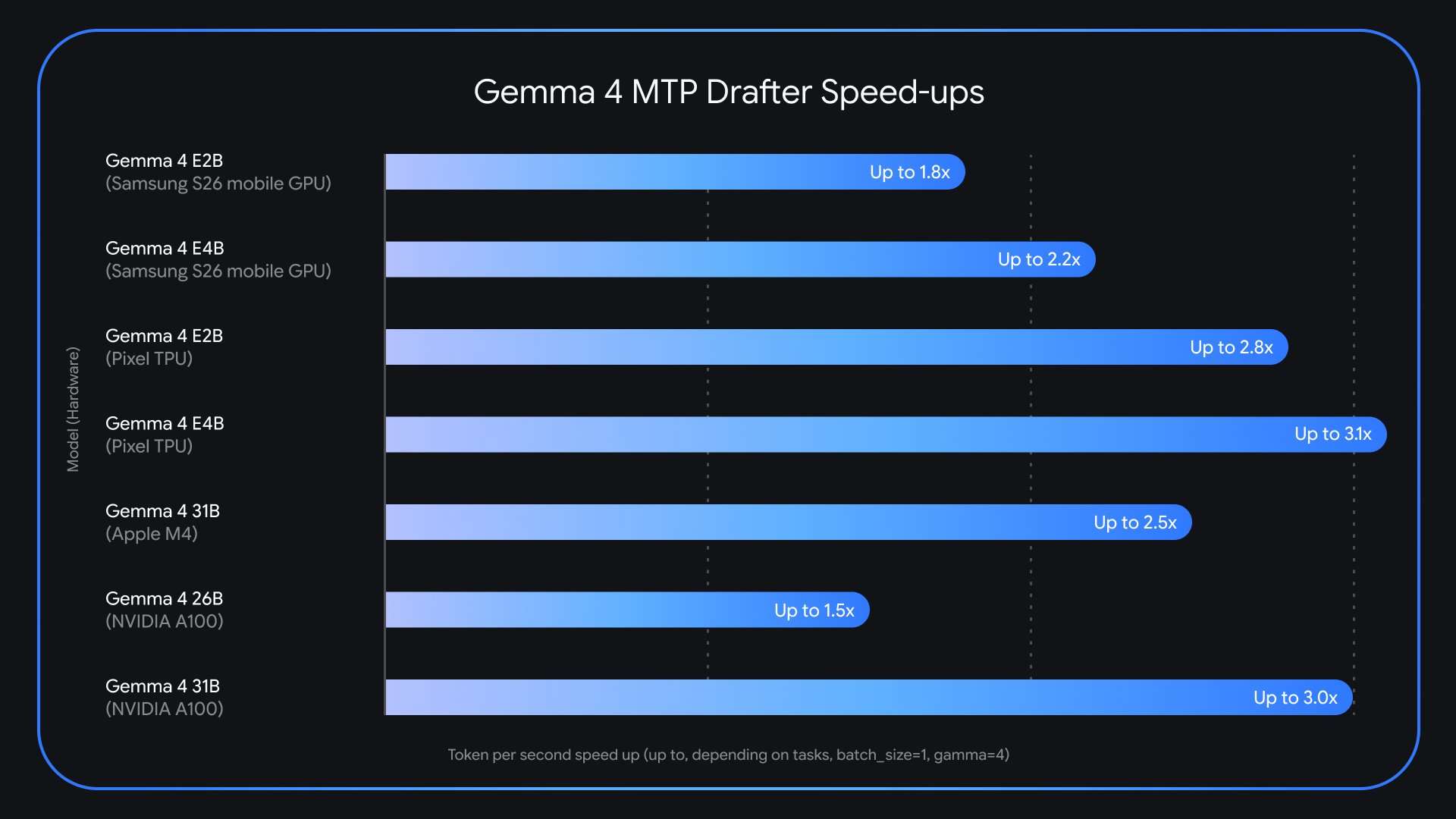
Google AI Releases Multi-Token Prediction (MTP) Drafters for Gemma 4: Delivering Up to 3x Faster Inference Without Quality Loss
MarkTechPost
When Claude Hallucinates in Court: The Latham & Watkins Incident and What It Means for Attorney Liability
MarkTechPost
Solidity LM surpasses Opus
Reddit r/LocalLLaMA


