
Imperative Interference: Social Register Shapes Instruction Topology in Large Language Models
arXiv cs.CL / 3/27/2026
💬 OpinionIdeas & Deep AnalysisModels & Research
Key Points
- The paper finds that English system prompt instructions with cooperative behavior can produce opposite “interaction topology” when translated to Spanish, even when the semantic content is the same.
- Instruction-level ablation across four languages and four models shows that the inversion is mediated by social register, especially differences in how imperative mood conveys obligatory force across speech communities.
- Declarative rewriting of imperative instruction blocks substantially reduces cross-linguistic variance (81% reduction, p = 0.029), and rewriting only some imperative blocks can change Spanish instruction behavior with spillover to unrewritten blocks.
- The authors argue that LLMs may treat instructions as “social acts” rather than purely technical specifications, implying language-dependent alignment risks when alignment principles are authored in imperative form.
- The work proposes a testable prediction that “constitutional AI” guidance written in imperative mood may lead to language-dependent alignment outcomes during training and inference.
広告
Related Articles

Got My 39-Agent System Audited Live. Here's What the Maturity Scorecard Revealed.
Dev.to

The Redline Economy
Dev.to

$500 GPU outperforms Claude Sonnet on coding benchmarks
Dev.to

From Scattershot to Sniper: AI for Hyper-Personalized Media Lists
Dev.to
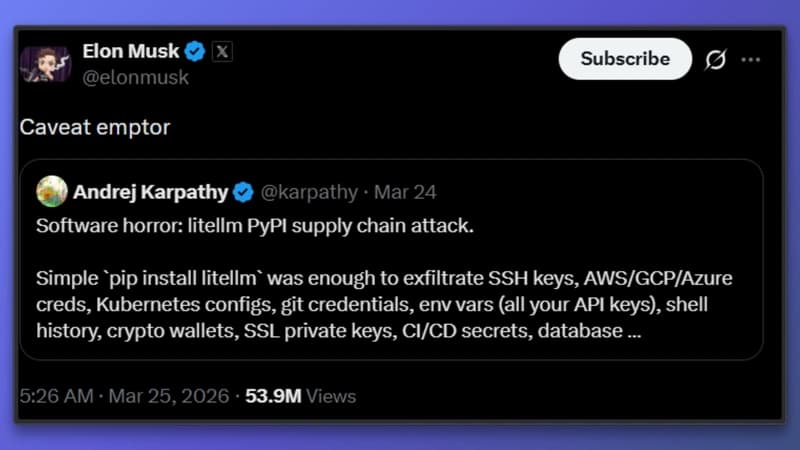
The LiteLLM Supply Chain Attack: A Wake-Up Call for AI Infrastructure
Dev.to


