
Disentangling Shared and Task-Specific Representations from Multi-Modal Clinical Data
arXiv cs.LG / 5/6/2026
📰 NewsModels & Research
Key Points
- The paper proposes a multi-task framework for multimodal clinical prediction that more carefully separates information that is shared across outcomes from signals that are specific to each outcome.
- It introduces Orthogonal Task Decomposition (OrthTD), which splits patient representations into shared and task-specific subspaces and uses a geometric orthogonality constraint to reduce redundancy and mitigate negative transfer.
- The approach is implemented on a unified Transformer architecture for multimodal fusion, aiming to balance shared representation learning with outcome-specific modeling.
- Experiments on a real cohort of 12,430 surgical patients (predicting four outcomes) show improved performance, achieving an average AUC of 87.5% and AUPRC of 37.2%, with especially strong gains on AUPRC for rare-event detection.
- The findings suggest that enforcing non-redundant shared/task-specific representations can enhance multi-outcome prediction from complex multimodal clinical datasets.
Related Articles
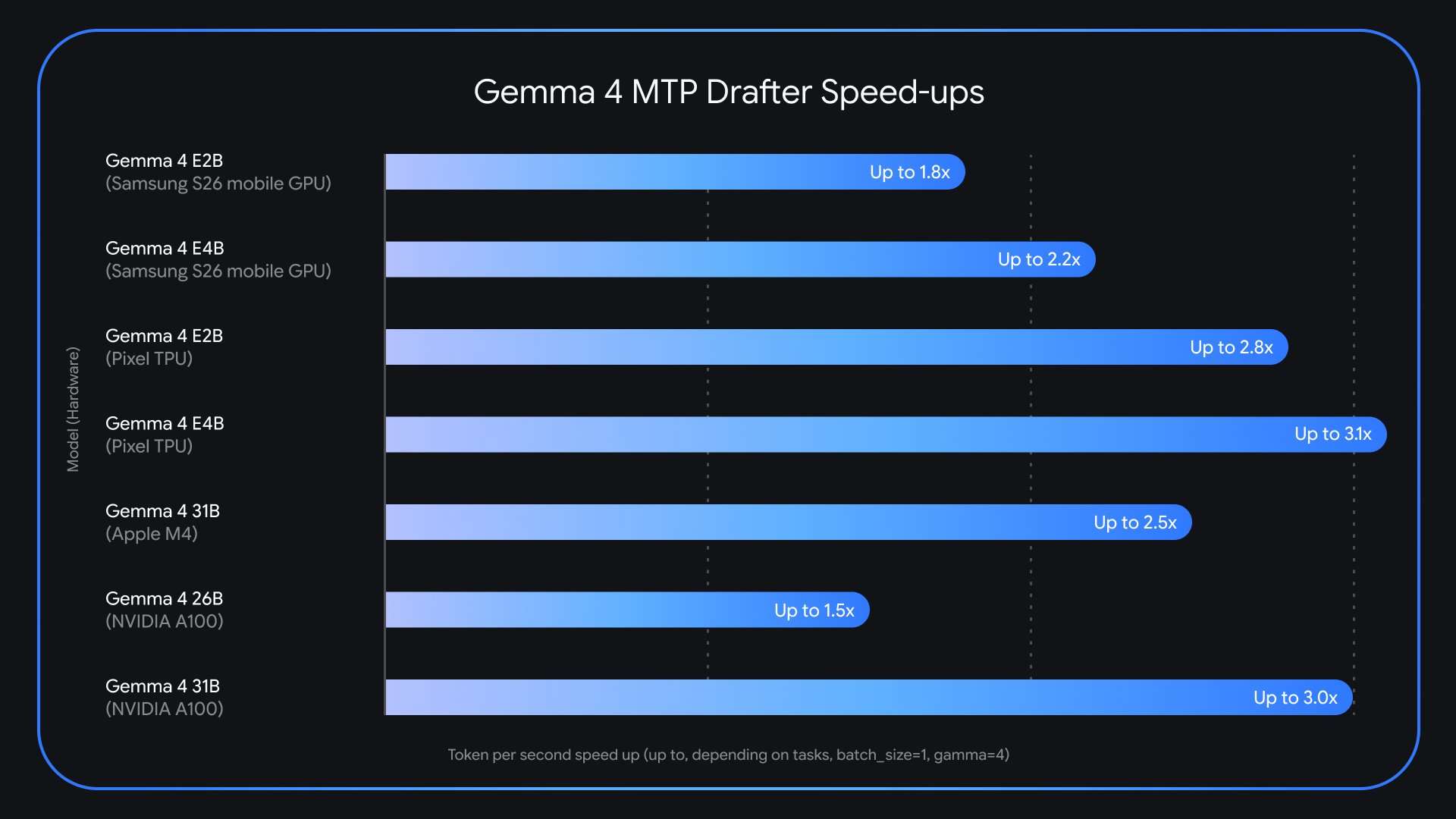
Google AI Releases Multi-Token Prediction (MTP) Drafters for Gemma 4: Delivering Up to 3x Faster Inference Without Quality Loss
MarkTechPost
Solidity LM surpasses Opus
Reddit r/LocalLLaMA

Quality comparison between Qwen 3.6 27B quantizations (BF16, Q8_0, Q6_K, Q5_K_XL, Q4_K_XL, IQ4_XS, IQ3_XXS,...)
Reddit r/LocalLLaMA

We measured the real cost of running a GPT-5.4 chatbot on live websites
Reddit r/artificial

AI ecosystems in China and US grow apart amid tech war
SCMP Tech


