
A Unified Memory Perspective for Probabilistic Trustworthy AI
arXiv cs.LG / 3/27/2026
💬 OpinionIdeas & Deep AnalysisModels & Research
Key Points
- The paper argues that trustworthy AI workloads that combine probabilistic sampling with deterministic data access increasingly become constrained by memory performance rather than compute arithmetic units.
- It proposes a unified perspective where deterministic access can be seen as a special (limiting) case of stochastic sampling, allowing both workload modes to be analyzed within one framework.
- The authors show that higher stochastic sampling demand can reduce effective data-access efficiency and potentially push systems into “entropy-limited” operation.
- They introduce memory-centric evaluation criteria—such as unified operation, distribution programmability, efficiency, robustness to hardware non-idealities, and parallel compatibility—to assess and compare architectures.
- Using these criteria, the paper critiques conventional architectures and surveys probabilistic compute-in-memory approaches, suggesting design pathways for scalable trustworthy AI hardware.
広告
Related Articles
Got My 39-Agent System Audited Live. Here's What the Maturity Scorecard Revealed.
Dev.to
The Redline Economy
Dev.to
$500 GPU outperforms Claude Sonnet on coding benchmarks
Dev.to
From Scattershot to Sniper: AI for Hyper-Personalized Media Lists
Dev.to
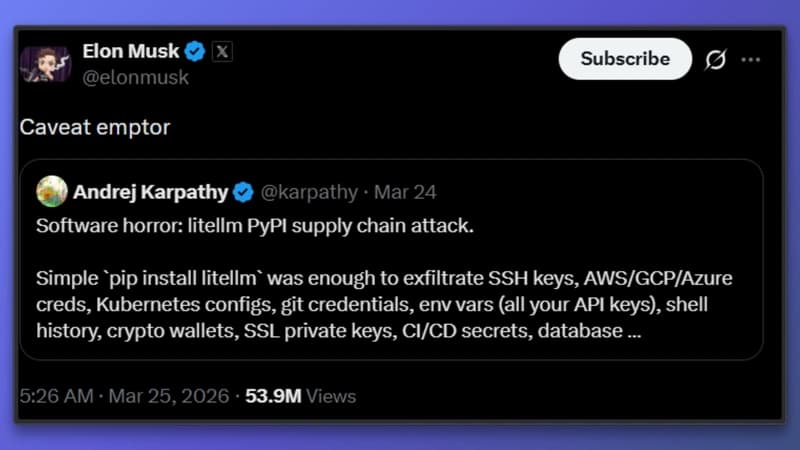
The LiteLLM Supply Chain Attack: A Wake-Up Call for AI Infrastructure
Dev.to


