
GaitKD: A Universal Decoupled Distillation Framework for Efficient Gait Recognition
arXiv cs.CV / 4/30/2026
📰 NewsDeveloper Stack & InfrastructureTools & Practical UsageModels & Research
Key Points
- The paper introduces GaitKD, a knowledge distillation framework aimed at improving efficient gait recognition models that are otherwise hard to deploy due to heavy architectures.
- GaitKD decouples distillation into two parts—decision-level distillation using part-calibrated logit distillation, and boundary-level distillation using an activation-boundary objective to preserve the teacher’s embedding-space partitioning.
- Instead of direct feature regression, the framework uses boundary preservation to achieve more stable student performance, especially for part-structured supervision signals.
- Experiments on multiple gait recognition benchmarks with various teacher–student configurations show consistent gains over strong baselines without adding inference-time cost.
- The authors report that the two transfer components are complementary and release source code on GitHub for replication and further use.
Related Articles

Black Hat USA
AI Business
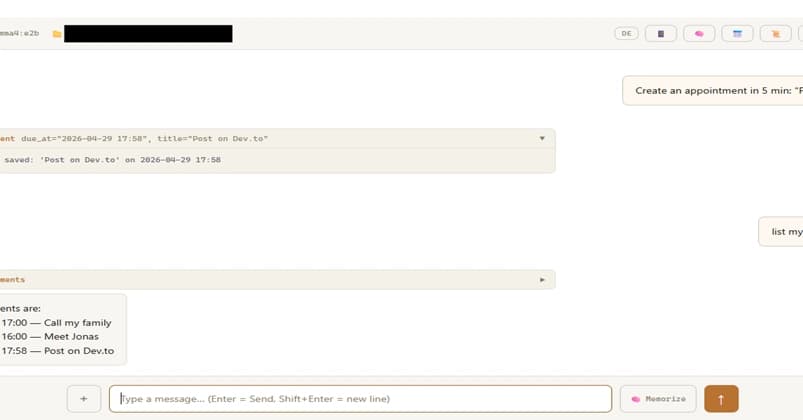
Building a Local AI Agent (Part 2): Six UX and UI Design Challenges
Dev.to

The Prompt Caching Mistake That's Costing You 70% More Than You Need to Pay
Dev.to

We Built a DNS-Based Discovery Protocol for AI Agents — Here's How It Works
Dev.to

Your first business opportunity in 3 commands: /register_directory in @biznode_bot, wait for matches, then /my_pulse to view...
Dev.to


