

HP stuffs OpenAI LLM into new laptops to make them either more useful at work, or a bit creepy
'HP IQ' can chat, share files, and record and summarize meetings


You’ve heard the call of Apple Intelligence, jumped for joy over Google Gemini, and cuddled up with Microsoft Copilot. Now, get ready for HP IQ, a local AI and collaboration application HP Inc. hopes will make its business laptops stand apart.
The printer profiteer announced HP IQ on Tuesday and said it comprises three elements: an LLM you can chat with or grant access to documents, a meeting summarizer, and HP NearSense, which allows you to seamlessly share files with coworkers in your vicinity or log into a meeting room’s HP Poly conferencing system just by being there.
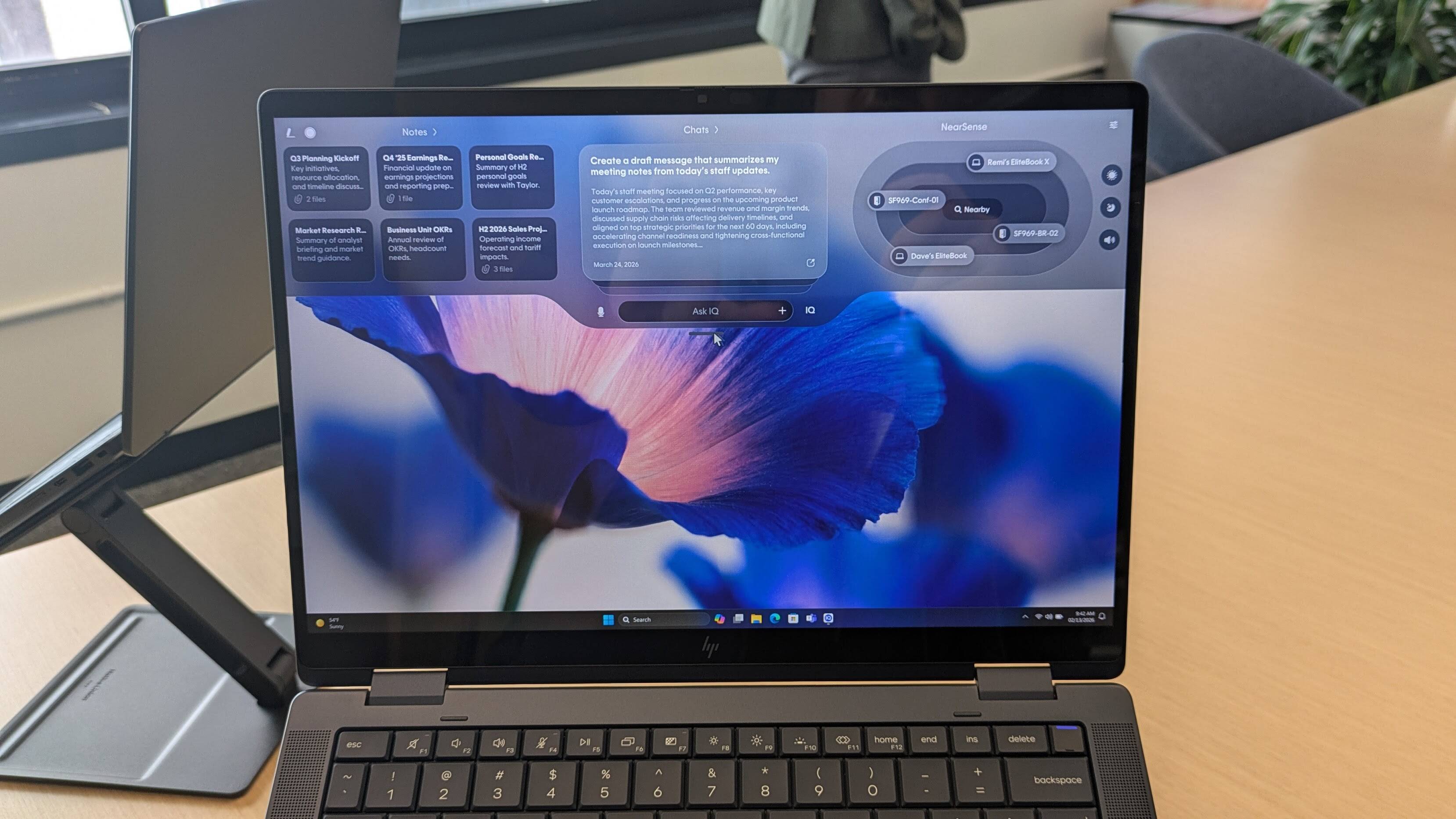
HP IQ with meetings, chats, and NearSense features - Click to enlarge
“We see a big opportunity to help people thrive more in the workplace,” Matt Brown, head of product for HP IQ, told The Register. “And to do that we’re creating this layer of intelligence that will stretch across our devices and really come to life in our AI PCs and make them more valuable than ever before and provide a really powerful model right there inside the PC.”
To run HP IQ when an early access program kicks off later this northern spring, you will need one of the company’s new 2026 EliteBook or ProBook models designated as an “AI PC” (which should include most if not all of the SKUs) with at least 24 GB of RAM. The company plans to expand to other HP notebooks, desktops, and Poly Studio Video Bars by the northern summer, with new HP IQ devices coming out in the second half of the year.
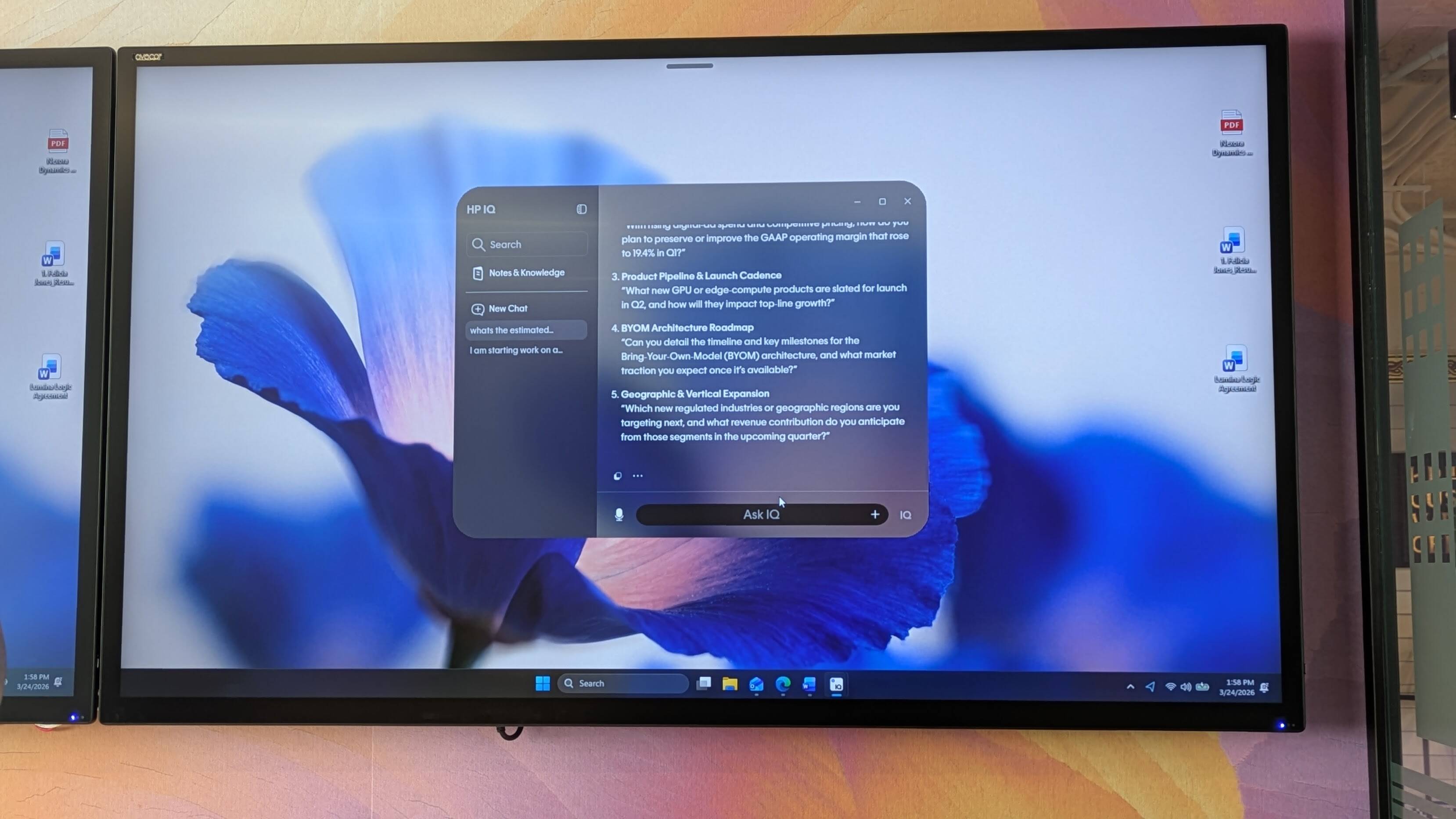
HP IQ chat window - Click to enlarge
In a demo, an HP rep uploaded a sensitive document to a PC and then asked the IQ bot, which is based on OpenAI’s gpt-oss-20b, to analyze it. He then asked it to help him write an overview of a board meeting he was planning. It did both of these tasks quickly and with great detail.
The rep then showed off the meeting agent portion of HP IQ, which lets you record in-person meetings using your laptop’s microphones and then use that data to generate action items and summaries. The tool also allows users to ask questions like “what were some of the top concerns shared by the team” – without mentioning whether the team might be concerned that they are being recorded for the benefit of AI. That’s definitely not creepy at all!
When The Register raised potential privacy concerns to Brown, he said that HP recommends that anyone recording their coworkers should follow best practice and ask all meeting participants for permission first. He also pointed out that online meetings are routinely recorded these days. And he said that HP IQ does not store the audio from the recordings, nor does it make a full transcript available, both of which might actually be useful features for some.
The Register notes that if you attend a meeting in which someone is recording you with HP IQ, you won’t be aware of it unless you can see their screen.
HP also showed the NearSense feature, which currently has two main capabilities but will eventually have more.
First, it can show you a list of coworkers who are in the same room as you and then allow you to send them files just by drag and drop – meaning HP has caught up with the Air Drop feature that macOS has offered for years. NearSense can also log you into meetings or start a meeting on the HP Poly conferencing hardware that’s in the same room as you.
HP reps told us that HP IQ uses a variety of sensors, including Wi-Fi, Bluetooth, and your microphone, to detect whether users are in the same room as a Poly conferencing device. They said that the technology is so accurate that, if you’re standing just outside the glass door of a room, it will not register you. A part of the setup process involves some kind of room mapping.
The company says that it plans to add more proximity-based features in the future such as the ability to print to nearby IQ-enabled printers, pair with headsets that are close to you, and to cast a PC’s screen to adjacent displays or conference room screens. HP said that it already has a three-year roadmap for the product.
HP also said that it plans to make HP IQ compatible with Android devices in the near future. This would allow the local file sharing and conferencing features to work on millions of phones.
If you’re thinking about local AI, HP IQ begs the question: why not just install your own LLM models using tools such as Ollama? Could you not accomplish many of these tasks with other tools that are not HP-specific?
“We think of IQ as coexisting really well with existing tools users might like, but this adds additional capabilities, the ability to process things locally and securely, right there on their PC,” Brown said. “It also ties into the other devices they use in the office in ways that other tools don’t.”
The gpt-oss-20b model that HP IQ uses for its local AI processing was trained in September 2025, HP reps said. To access more recent current data such as the weather or stock quotes, it accesses the Internet to grab new info. Brown said that IT departments can set a policy to shut this off. It remains unclear how much notice users will have that their local model is polling the Internet.
- How OpenAI used a new data type to cut inference costs by 75%
- HP says memory's contribution to PC costs just doubled to 35 percent
- HP Inc settles printer toner lockout lawsuit with a promise to make firmware updates optional
- The last supported version of HP-UX is no more
“Every PC OEM is trying to do their own thing,” Anshel Sag, an analyst with Moor Insights told The Register. “HP’s approach seems to be very focused on productivity and I think they’ve messaged it in a way that sounds enterprise focused, but I think it’s more SMB than enterprise.”
Sag told us that there aren’t many dead simple local AI tools out there and HP’s offering would make it easy for people who are not experts or hobbyists to use on-device AI models.
However, he emphasized that HP must keep updating the model to stay competitive and that smaller businesses, rather than large enterprises, will be the first to take advantage of the tools. He said that HP had gone with gpt-oss-20b because it was likely the best local model at the time the company froze development, but he predicted the company could swap it if a better model comes along.
“I think there’s some really interesting things that they can do with document scanning and meeting notes and things like that could really enable people to be more productive and have a better PC experience,” he said. “But I still think there’s a lot more that they could do to be useful and I think this is just the first step.” ®


