
Learning Multi-Agent Local Collision-Avoidance for Collaborative Carrying tasks with Coupled Quadrupedal Robots
arXiv cs.RO / 3/25/2026
📰 NewsSignals & Early TrendsIdeas & Deep AnalysisModels & Research
Key Points
- The paper targets collaborative carrying with multiple mechanically coupled quadrupedal robots, focusing on safe coordination in environments that include obstacles rather than only obstacle-free spaces.
- It introduces an RL-based hierarchical control system that tracks a commanded velocity direction while avoiding collisions using only onboard sensing, removing the need for precomputed trajectories or full map knowledge.
- A high-level object-centric policy selects actions that command two pretrained locomotion policies, enabling coordinated motion without centralized trajectory planning.
- The method uses a game-inspired curriculum to progressively increase terrain and obstacle complexity during training.
- Experiments on two coupled quadrupeds in unknown environments show improved performance against optimization-based and decentralized RL baselines, and demonstrate map- and path-planner-free locomotion.
広告
Related Articles

Got My 39-Agent System Audited Live. Here's What the Maturity Scorecard Revealed.
Dev.to

The Redline Economy
Dev.to

$500 GPU outperforms Claude Sonnet on coding benchmarks
Dev.to

From Scattershot to Sniper: AI for Hyper-Personalized Media Lists
Dev.to
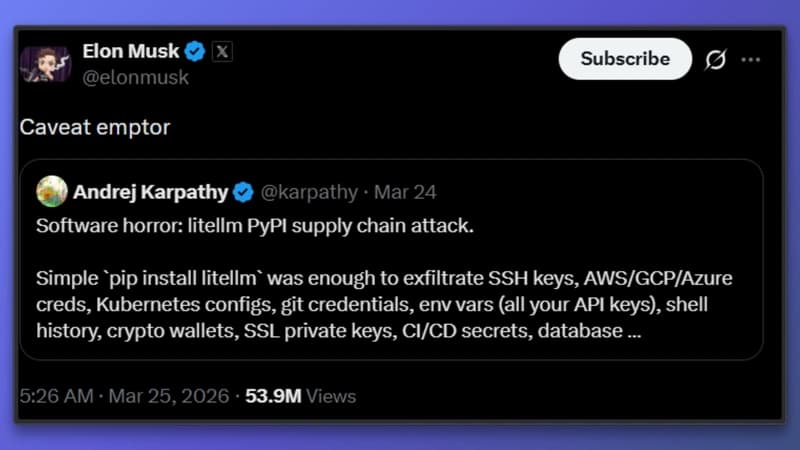
The LiteLLM Supply Chain Attack: A Wake-Up Call for AI Infrastructure
Dev.to


