
Koopman Operator Framework for Modeling and Control of Off-Road Vehicle on Deformable Terrain
arXiv cs.RO / 4/1/2026
💬 OpinionIdeas & Deep AnalysisModels & Research
Key Points
- The paper introduces a hybrid physics-informed and data-driven Koopman-operator framework to model deformable-terrain dynamics for predictive control of autonomous off-road vehicles.
- Instead of using computationally expensive high-fidelity terramechanics directly in control design, the approach constructs a linear Koopman system from simulation data to capture complex vehicle/terrain behavior.
- Deformable terrain is simulated using Bekker-Wong terramechanics, while the vehicle dynamics are approximated as a simplified five-degree-of-freedom (5-DOF) model.
- Koopman operators are identified from large sandy-loam and clay simulation datasets via recursive subspace identification, with Grassmannian distance used to select informative training data segments.
- The learned Koopman predictor is shown to provide stable, robust short-horizon predictions under mild terrain-height variations and supports constrained MPC for stable closed-loop tracking of aggressive maneuvers within steering and torque limits.
Related Articles

Show HN: 1-Bit Bonsai, the First Commercially Viable 1-Bit LLMs
Dev.to

I Built an AI Agent That Can Write Its Own Tools When It Gets Stuck
Dev.to

Agent Self-Discovery: How AI Agents Find Their Own Wallets
Dev.to
[P] Federated Adversarial Learning
Reddit r/MachineLearning
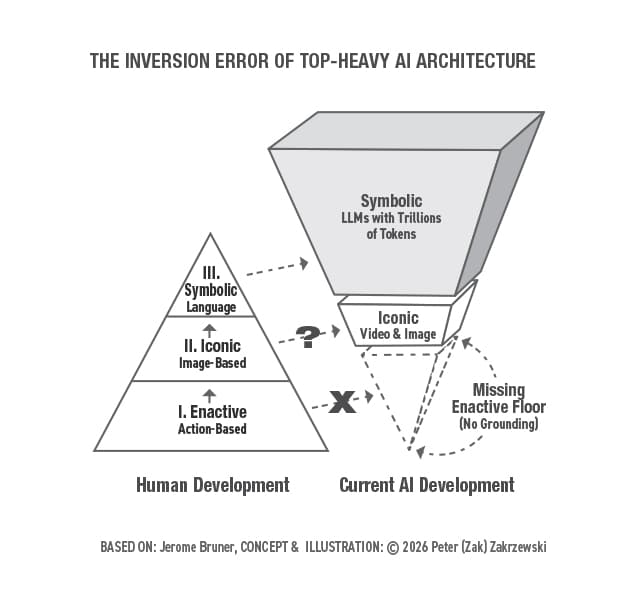
The Inversion Error: Why Safe AGI Requires an Enactive Floor and State-Space Reversibility
Towards Data Science


