
Meta's latest model is as open as Zuckerberg's private school

You were the chosen one! It was said that you would destroy the proprietary models, not join them!


Nearly two years after extolling the virtues of open source AI, Meta CEO Mark Zuckerberg is singing a different tune.
On Wednesday, the social media magnate unveiled its first new model developed by its Superintelligence team. But this is no Llama, and you can't download its weights.
The model, dubbed Muse Spark, is proprietary with access limited to Meta's AI portal or API access for those lucky enough to get an invite. Yep, this thing's locked down tighter than Zuck's private school.
Detailed in a blog post, Meta described the model as the "first step on our scaling ladder and the first product of a ground-up overhaul of our AI efforts."
Meta's decision not to release Muse Spark's weights comes in stark contrast to Zuckerberg's earlier position that "open source AI represents the world's best shot at harnessing this technology to create the greatest economic opportunity and security for everyone."
Those comments came forth in a 2,000-plus-word manifesto titled "Open Source AI is the Path Forward," in which Zuckerberg waxed poetic on the merits of open source AI.
"If we were the only company using Llama, this ecosystem wouldn't develop and we'd fare no better than the closed variants of Unix," Zuckerberg wrote, drawing comparisons to the rise of the Linux operating system.
"Opening Llama doesn't undercut our revenue, sustainability, or ability to invest in research like it does for closed providers," he argued, emphasizing that Meta's business model didn't depend on selling access to its models, either.
That was the case until about a year later, when Meta launched its Llama API inference service, alongside its Llama 4 family of models.
But never fear, Zuckerberg hasn't given up on open models entirely. "Looking ahead, we plan to release increasingly advanced models that push the frontier of intelligence and capabilities, including new open source models," he wrote in a Threads post.
This kind of dual-tracking is common. In fact, Google routinely releases small open weights models derived from its larger proprietary Gemini models, with its Gemma 4 family being the latest example. OpenAI has made similar moves with gpt-oss, though it remains to be seen if that was a one-off or not.
But if Zuckerberg actually believed any of what he wrote in 2024, why bother with a closed model in the first place?
Perhaps because even though Meta hyped Llama 4's multimodal and agentic capabilities, the model never lived up to expectations, with Meta ultimately abandoning development of its largest variant, codenamed Behemoth, which would have weighed in at 2 trillion parameters.
The flop was apparently embarrassing enough that Meta started over from scratch, paying top dollar to woo top AI software engineers and executives, including Alexandr Wang, who now leads Meta Superintelligence Labs.
- AI will make anyone a 10x programmer, but with 10x the cleanup
- Surprise! Big Tech has been a bit rubbish at enforcing Australia's kids social media ban
- Microsoft takes up residence next to OpenAI, Oracle at Crusoe's 900 MW Texas datacenter expansion
- Folk are getting dangerously attached to AI that always tells them they're right
Will Zuck's new Muse Spark joy?
So it's not open source, you can't download it, but is it any good? It's a good question, because if it's not, Meta's shareholders might start to wonder why the company is so keen to light $135 billion on fire.
If Meta is to be believed, Muse Spark is a big improvement over Llama 4. The model boasts performance matching and in many cases besting the top models from OpenAI, Anthropic, and Google.
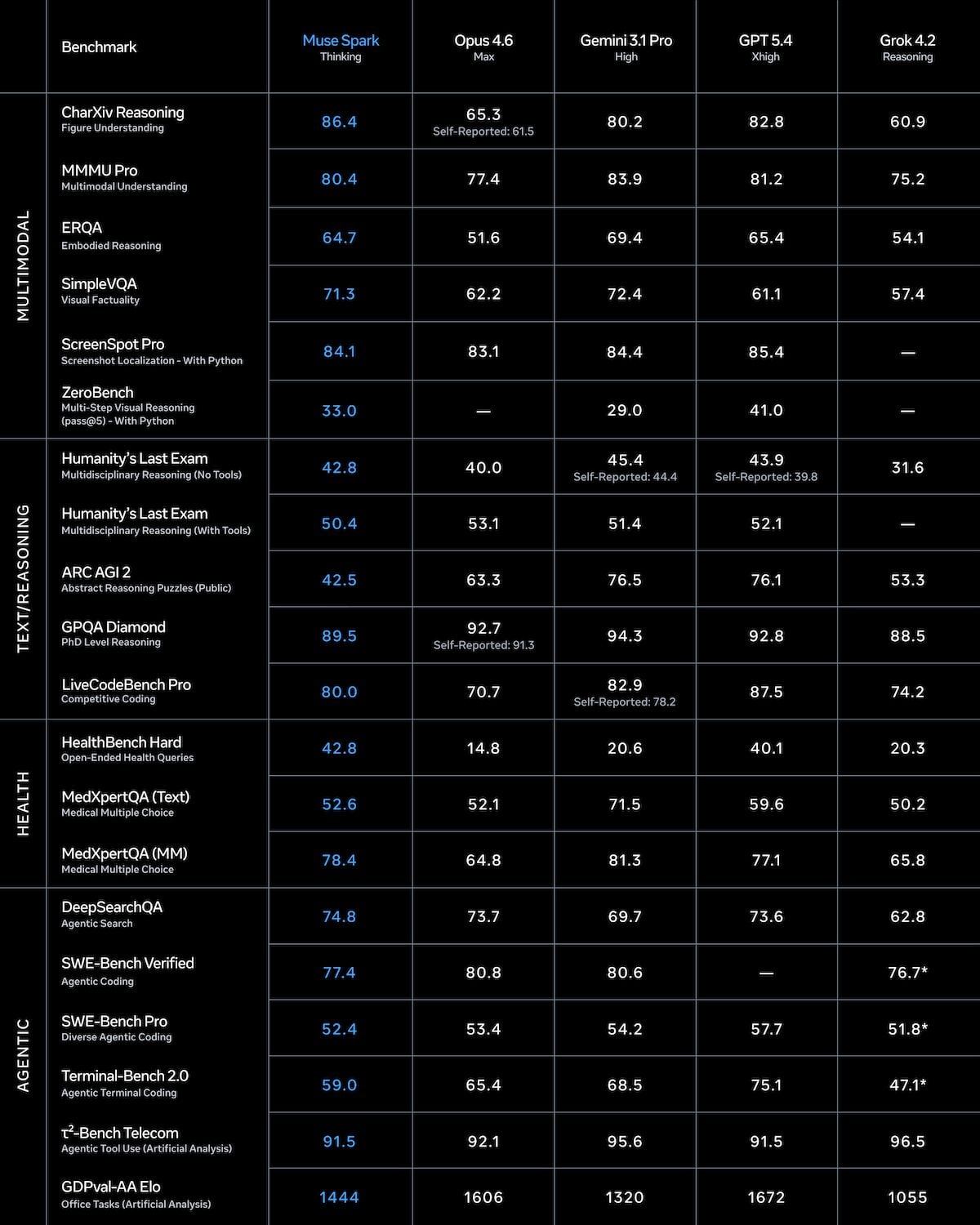
Here's how Meta says its new proprietary model compares to the AI heavyweights - Click to enlarge
But before you read too far into these benchmark numbers, remember that they're coming from a company that not that long ago was accused of pulling a bait-and-switch in order to make Llama 4 look better. Having said that, this time around Meta had the foresight to share its test methodology.
Compared to Llama 4, Meta claims Muse Spark was also more efficient to train, proving that "we can reach the same capabilities with an order of magnitude less compute than our previous model."
Meta didn't go into detail about the model's underlying architecture, describing it as a "natively multimodal reasoning model with tool-use, visual chain of thought, and multi-agent orchestration" capabilities.
Meta has also introduced what it calls a "contemplating mode," which orchestrates multiple reasoning agents working in parallel to compete with frontier models like Gemini Deep Think and GPT Pro. However, it doesn't appear that this function is generally available on day one. "Muse Spark is available now, and Contemplating mode will be rolling out gradually in meta.ai."
Spark is just the first in a new line of Muse models, with larger variants already in the works – and unlike Behemoth, we might actually get to see them. ®





