
Heterogeneous Adaptive Policy Optimization: Tailoring Optimization to Every Token's Nature
arXiv cs.CL / 4/30/2026
💬 OpinionIdeas & Deep AnalysisModels & Research
Key Points
- The paper proposes Heterogeneous Adaptive Policy Optimization (HAPO), a token-aware reinforcement learning algorithm for LLMs that uses entropy as a continuous core driver rather than a discrete filter or post-hoc regulator.
- HAPO dynamically adapts optimization using four components: adaptive temperature sampling, token-level group average advantage estimation, differential advantage redistribution, and asymmetric entropy-based adaptive clipping.
- The method continuously tailors optimization dynamics to each token’s entropy throughout training, aiming for fine-grained regulation and better handling of sequence-length effects.
- Experiments across mathematical reasoning, code, and logic tasks on multiple models show HAPO consistently outperforms DAPO, and the authors provide an implementation repository.
- The work advances RL-for-LLMs research by embedding token-level heterogeneity treatment into every stage of the optimization pipeline.
Related Articles
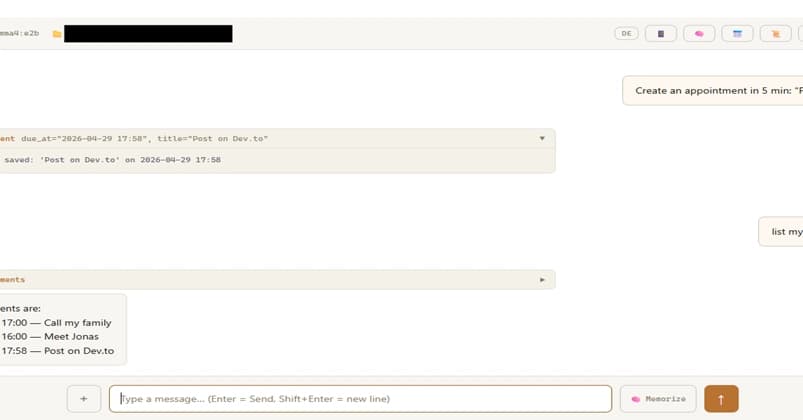
Building a Local AI Agent (Part 2): Six UX and UI Design Challenges
Dev.to

We Built a DNS-Based Discovery Protocol for AI Agents — Here's How It Works
Dev.to
Your first business opportunity in 3 commands: /register_directory in @biznode_bot, wait for matches, then /my_pulse to view...
Dev.to
Building AI Evaluation Pipelines: Automating LLM Testing from Dataset to CI/CD
Dev.to

Function Calling Harness 2: CoT Compliance from 9.91% to 100%
Dev.to


