
DGPO: Distribution Guided Policy Optimization for Fine Grained Credit Assignment
arXiv cs.LG / 5/6/2026
📰 NewsModels & Research
Key Points
- The paper proposes DGPO, a critic-free reinforcement learning framework aimed at improving how large language models learn complex reasoning tasks.
- It targets a key weakness of prior methods like Group Relative Policy Optimization, namely coarse, sequence-level credit assignment that makes it hard to pinpoint which reasoning steps matter in long chain-of-thought traces.
- DGPO addresses training instability by rethinking the typical unbounded KL-divergence penalty: distribution deviation is used as a guidance signal instead of a strict penalty.
- By reducing gradient instability and mode-seeking conservatism, the approach aims to enable more reliable exploration of new reasoning trajectories.
- The work is presented as a new arXiv submission (arXiv:2605.03327v1), inviting further evaluation and validation of the method’s effectiveness.
Related Articles
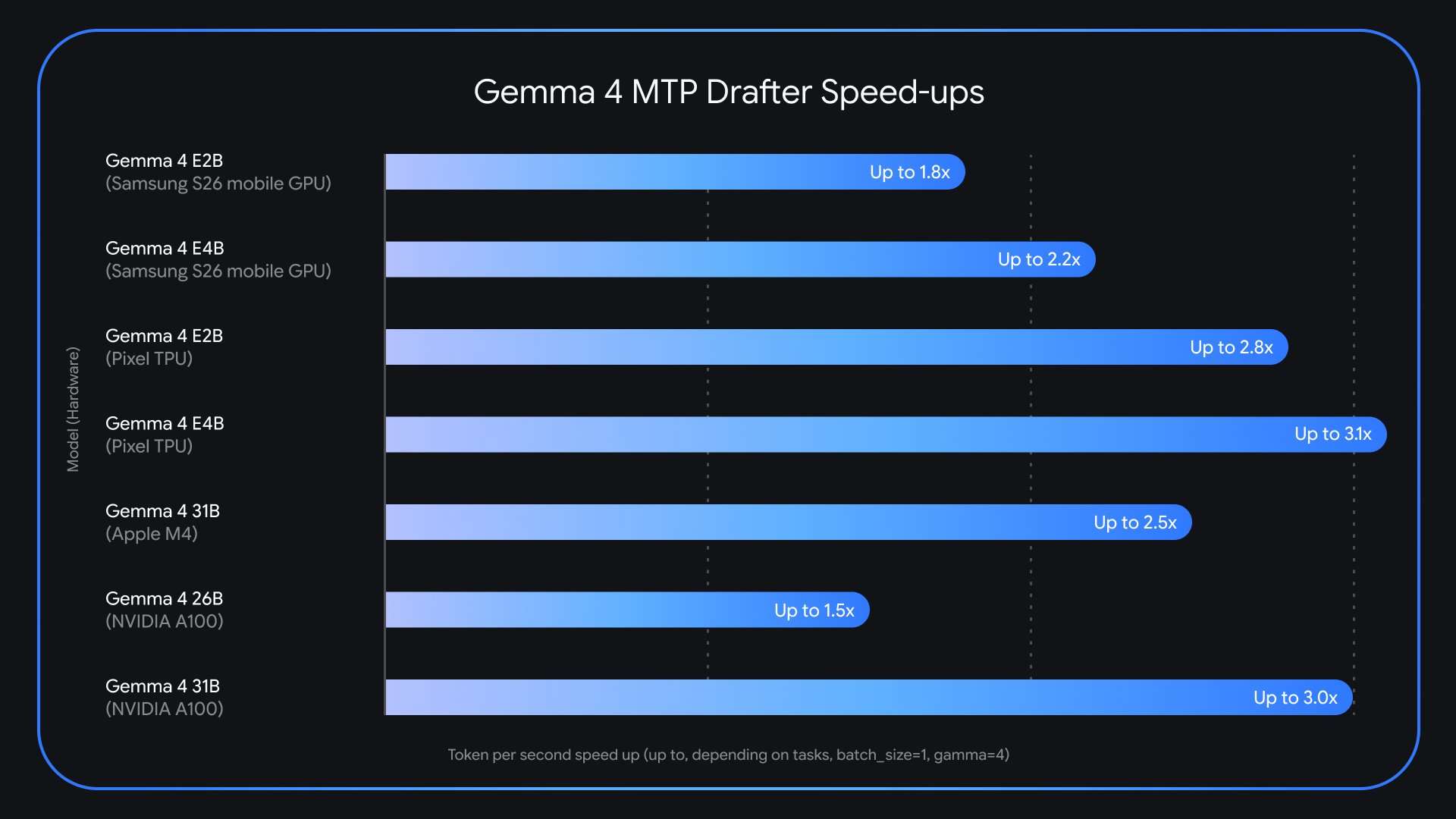
Google AI Releases Multi-Token Prediction (MTP) Drafters for Gemma 4: Delivering Up to 3x Faster Inference Without Quality Loss
MarkTechPost
Solidity LM surpasses Opus
Reddit r/LocalLLaMA

Quality comparison between Qwen 3.6 27B quantizations (BF16, Q8_0, Q6_K, Q5_K_XL, Q4_K_XL, IQ4_XS, IQ3_XXS,...)
Reddit r/LocalLLaMA

We measured the real cost of running a GPT-5.4 chatbot on live websites
Reddit r/artificial

AI ecosystems in China and US grow apart amid tech war
SCMP Tech


