
Dense Point-to-Mask Optimization with Reinforced Point Selection for Crowd Instance Segmentation
arXiv cs.CV / 4/3/2026
💬 OpinionSignals & Early TrendsIdeas & Deep AnalysisModels & Research
Key Points
- The paper addresses crowd instance segmentation where datasets commonly provide point labels, but high-quality region/mask labels are scarce and inaccurate, limiting downstream accuracy for counting and localization.
- It introduces Dense Point-to-Mask Optimization (DPMO), combining SAM with a Nearest Neighbor Exclusive Circle (NNEC) constraint to convert dense crowd point annotations into improved mask annotations (with optional manual correction).
- For prediction in dense scenes, it proposes Reinforced Point Selection (RPS), which uses Group Relative Policy Optimization (GRPO) to select the best point from sampled candidates before generating instance outputs.
- Experiments report state-of-the-art performance on multiple crowd datasets (ShanghaiTech, UCF-QNRF, JHU-CROWD++, NWPU-Crowd), and the authors show that mask-supervised losses can significantly improve counting accuracy across models.
- Overall, the work highlights that dense crowd segmentation can be improved by better point-to-mask pseudo-label generation and by reinforcement-style point selection rather than directly applying standard foundation-model prompting.
Related Articles

Black Hat Asia
AI Business

90000 Tech Workers Got Fired This Year and Everyone Is Blaming AI but Thats Not the Whole Story
Dev.to

Microsoft’s $10 Billion Japan Bet Shows the Next AI Battleground Is National Infrastructure
Dev.to
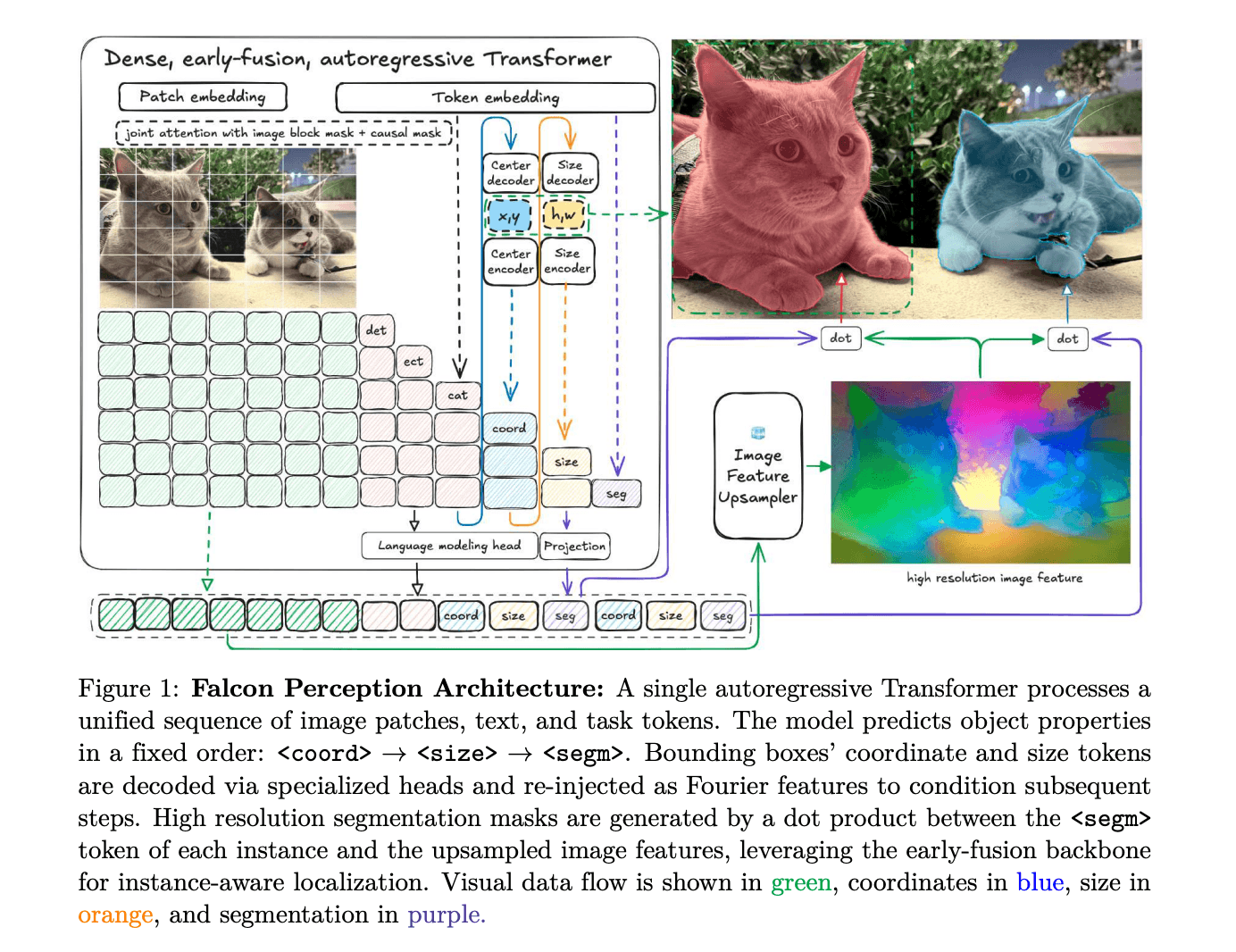
TII Releases Falcon Perception: A 0.6B-Parameter Early-Fusion Transformer for Open-Vocabulary Grounding and Segmentation from Natural Language Prompts
MarkTechPost

Portable eye scanner powered by AI expands access to low-cost community screening
Reddit r/artificial


