
Cloud Is Closer Than It Appears: Revisiting the Tradeoffs of Distributed Real-Time Inference
arXiv cs.AI / 5/4/2026
💬 OpinionDeveloper Stack & InfrastructureModels & Research
Key Points
- The paper revisits the common assumption that cloud-based inference is too slow for latency-sensitive cyber-physical system (CPS) control, arguing that network delays can be amortized with enough compute throughput.
- It introduces a formal analytical model of distributed inference latency that depends on sensing frequency, platform throughput, network delay, and task-specific safety constraints.
- Using emergency braking for autonomous driving as a concrete case study, the authors validate the model with extensive simulations based on real-time vehicular dynamics.
- The results specify conditions where cloud inference can meet safety margins more reliably than on-device inference, implying the cloud may be the preferred inference location for some distributed CPS designs.
- Overall, the work challenges traditional CPS architecture choices that prioritize on-device inference primarily to avoid network variability and contention delays.
Related Articles
SIFS (SIFS Is Fast Search) - local code search for coding agents
Dev.to
BizNode's semantic memory (Qdrant) makes your bot smarter over time — it remembers past conversations and answers...
Dev.to
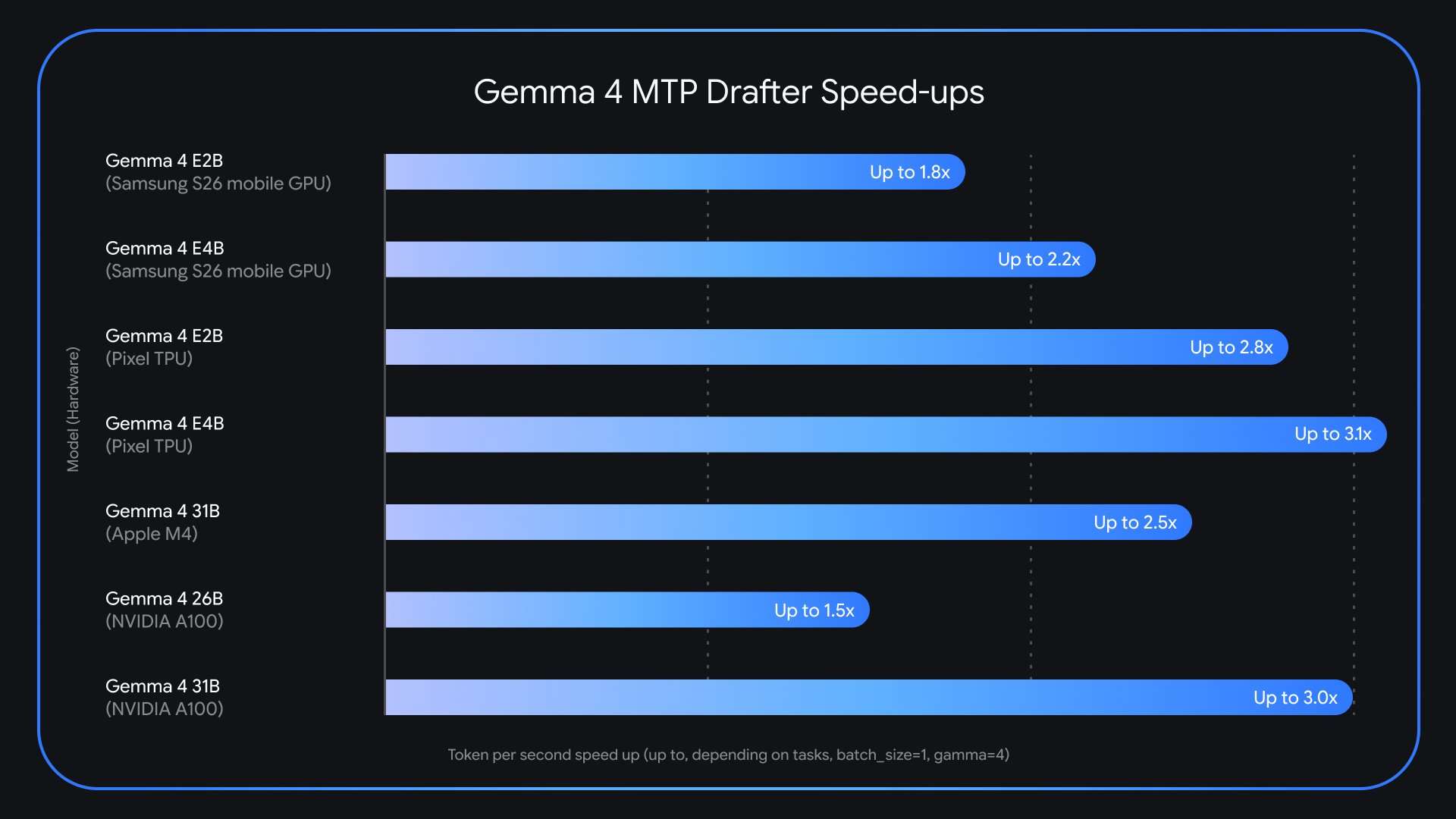
Google AI Releases Multi-Token Prediction (MTP) Drafters for Gemma 4: Delivering Up to 3x Faster Inference Without Quality Loss
MarkTechPost
Solidity LM surpasses Opus
Reddit r/LocalLLaMA

Quality comparison between Qwen 3.6 27B quantizations (BF16, Q8_0, Q6_K, Q5_K_XL, Q4_K_XL, IQ4_XS, IQ3_XXS,...)
Reddit r/LocalLLaMA


