
RFPrompt: Prompt-Based Expert Adaptation of the Large Wireless Model for Modulation Classification
arXiv cs.LG / 5/6/2026
📰 NewsIdeas & Deep AnalysisModels & Research
Key Points
- The paper addresses automatic modulation classification (AMC) in real-world settings where models must remain robust against distribution shifts from hardware impairments, new propagation environments, and unseen recording conditions.
- It proposes RFPrompt, a parameter-efficient, prompt-based adaptation method that adds learnable deep prompt tokens while freezing the pretrained wireless foundation model backbone to avoid overwriting pretrained representations.
- The approach is evaluated on the Large Wireless Model (LWM), a mixture-of-experts wireless foundation model, across both standard and out-of-distribution (OOD) modulation-classification scenarios.
- Experiments show that prompt-based adaptation improves robustness under distribution shift and limited supervision, especially on real over-the-air IQ data, while maintaining strong parameter efficiency.
- Overall, the results indicate that prompt learning is an effective strategy for adapting wireless foundation models to challenging downstream RF environments without retraining the full model.
Related Articles

Top 10 Free AI Tools for Students in 2026: The Ultimate Study Guide
Dev.to

AI as Your Contingency Co-Pilot: Automating Wedding Day 'What-Ifs'
Dev.to
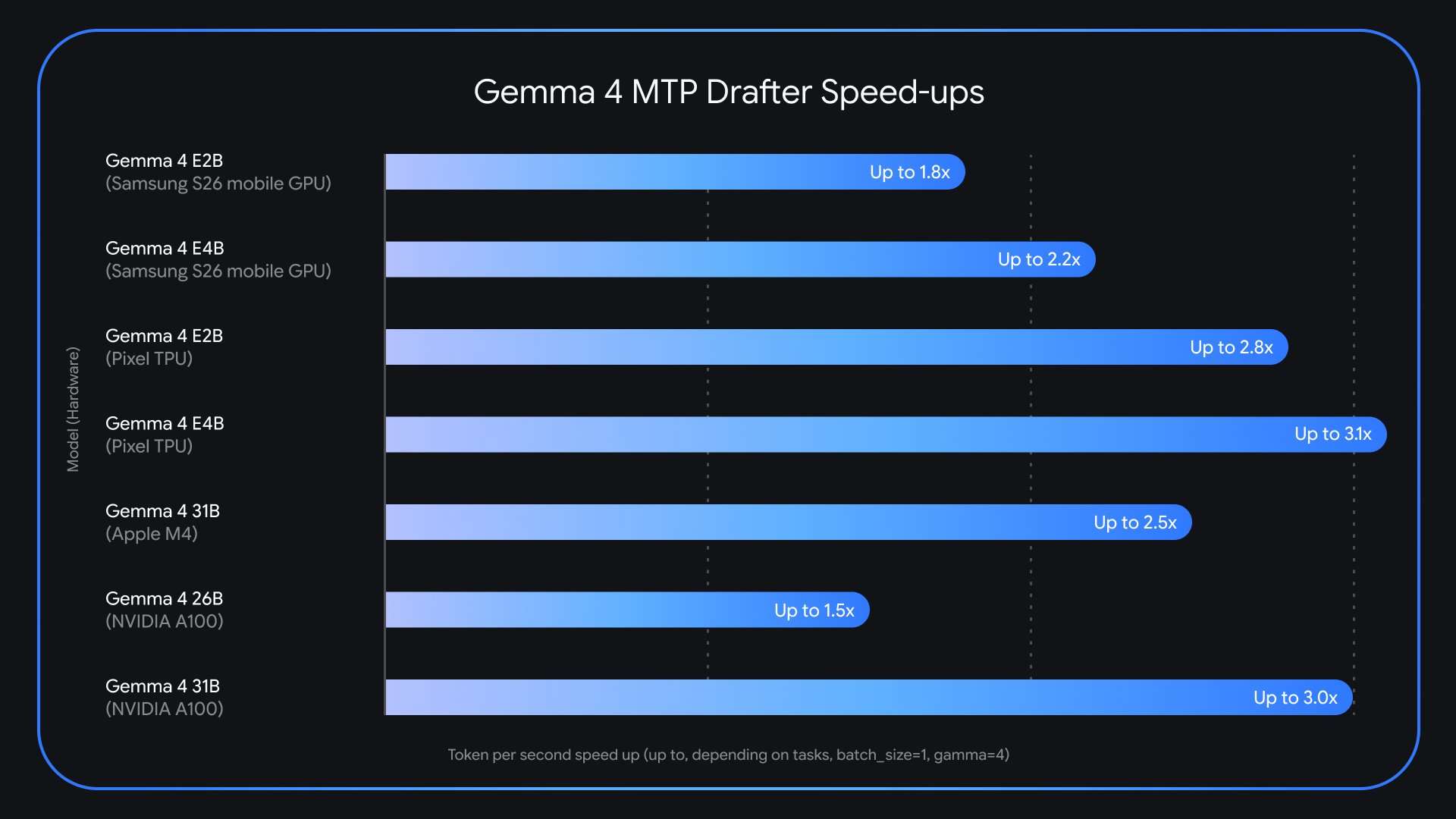
Google AI Releases Multi-Token Prediction (MTP) Drafters for Gemma 4: Delivering Up to 3x Faster Inference Without Quality Loss
MarkTechPost
When Claude Hallucinates in Court: The Latham & Watkins Incident and What It Means for Attorney Liability
MarkTechPost
Solidity LM surpasses Opus
Reddit r/LocalLLaMA


