Cloudflare previews 'EmDash' – an AI-driven rebuild of WordPress in TypeScript
Name is a joke but the project is real, said main engineer


The world's most popular CMS has been remade with the help of AI. Cloudflare has released EmDash version 0.1, described as a rebuild of the WordPress CMS (content management system) but using TypeScript rather than PHP.
In contrast to the one week claimed for recreating Next.js using agentic AI, Cloudflare's product manager Matt Taylor and software engineer Matt Kane said that it took all of two months to create EmDash. Further, the code for EmDash is based on Astro, an open source JavaScript framework acquired by Cloudflare in January this year, so is not altogether newly generated by AI. Technically EmDash is an Astro integration.
"I'm the main engineer on this. I've also been on the Astro core team for two years, so I do think I understand real open source software and community. As the post implies, I did use a lot of agent time on this, but this isn't a vibe-coded weekend project. I've been working full time on this since mid-January," said Kane on Hacker News.
According to the introductory post, "while EmDash aims to be compatible with WordPress functionality, no WordPress code was used to create EmDash." The new project is open source on GitHub under the MIT license.
"The effort needed to be certain it was safe to MIT license EmDash really drove home why it was important to MIT license it. For a lot of enterprises, GPL software is free only if your lawyers are free," said Kane.
WordPress is used by 42.5 percent of all websites and 59.8 percent of all CMS systems based on stats from w3techs. That makes it a huge target market, with Cloudflare's goal being to get some of those sites to migrate to run on its Workers platform. Cloudflare Workers are based on V8 isolates, where V8 is the JavaScript engine used by Google's Chrome web browser. An isolate is a sandboxed instance of V8 and is lightweight.
This means that, unlike WordPress, EmDash is serverless and scales to zero if there are no requests, or scales up to millions of instances when busy.
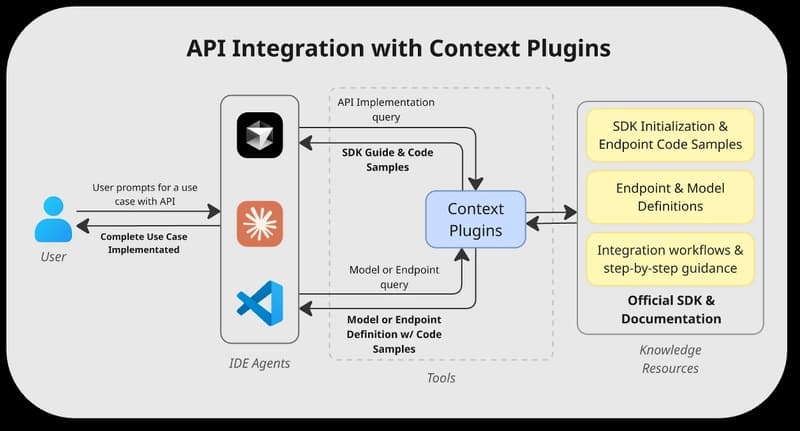
"Name is a joke but the project is real," said Kane, in answer to a query about whether this project was an April fool, since it was announced on April 1st. Perhaps it will be renamed soon; but 'EmDash' may be playing on the notion that use of the em dash is a sign of AI authorship. This is not normally something to be proud of, but we note that the company describes EmDash as AI native, with a built-in MCP (model context protocol) server, with full admin access, and Agent Skills configuration files for tasks such as converting WordPress themes.
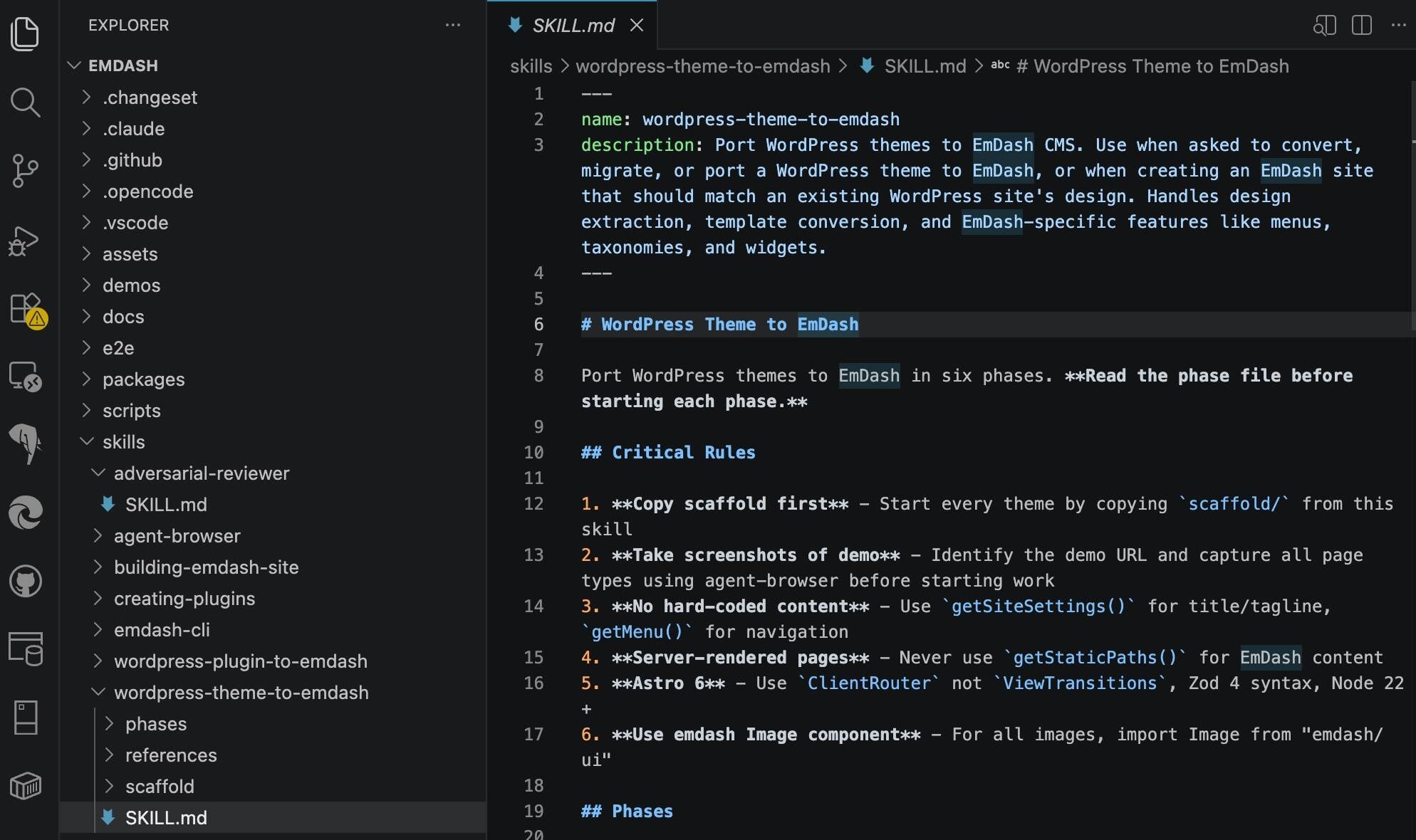
Skills are configured to make it easier to convert plugins and themes with agentic AI - Click to enlarge
The rationale for EmDash, aside from being a marketing pitch for Workers, is that along with AI integration, it is more secure and more easily scaled than WordPress. WordPress plugins and themes are vulnerable to security issues since they are generally not isolated. EmDash plugins run in a sandbox and have defined permissions, such as "read:content" and "email:send" in the case of an email plugin.
EmDash authentication uses Passkeys by default, with a fallback to emailed magic links, and no support for passwords. This is a step up from simple username/password, though we encountered problems with the early code as our local setup on Linux did not work with the passkey and the magic link returned "page not found." No doubt this will be fixed soon.
The project includes a WordPress migration tool but this only imports content. Most WordPress sites make extensive use of plugins and themes, coded in PHP. This means that replicating an existing site in EmDash will not be easy, requiring re-coding of themes and plugins perhaps with AI assistance as mentioned above.
It is also possible that existing plugins and themes will be converted by others. Joost de Valk, who created the Yoast SEO plugin for WordPress, is an early enthusiast for EmDash. According to De Valk, "every architectural decision in EmDash seems to have been made with the same question: what if an AI agent needs to do this?"
One of the consequences is that if an AI agent is asked to build a new website using EmDash, it will have an easier time thanks to the AI-friendly design, such as documentation "structured for machine consumption," said De Valk.
Points against EmDash are that is has no plugin ecosystem yet, no community, and that Cloudflare integration introduces friction for those who prefer to self-host or host elsewhere. The EmDash readme states that "It runs best on Cloudflare, but it's not locked to it." When self-hosting, there is currently no support for sandboxed plugins.
Despite the above, De Valk stated that he plans to develop "on and with EmDash."
Regardless of its future, EmDash is a project that raises key questions, first about how AI is reshaping software design, and second about the notion that one can migrate from one application to another by instructing AI to replicate the bits of it that are needed. ®