
Spontaneous Functional Differentiation in Large Language Models: A Brain-Like Intelligence Economy
arXiv cs.AI / 4/1/2026
💬 OpinionIdeas & Deep AnalysisModels & Research
Key Points
- A new arXiv study reports that large language models spontaneously form “synergistic cores” where integrated information processing in middle layers exceeds what individual components produce.
- The researchers use Integrated Information Decomposition across multiple model architectures, finding a pattern where middle layers show synergy while early and late layers are more redundant.
- They describe the emergence of this layer organization as dynamic and resembling a physical phase transition as task difficulty increases.
- Ablation experiments removing the synergistic components lead to catastrophic performance drops, which the authors interpret as evidence that these components underpin abstract reasoning and potentially bridge artificial and biological intelligence.
Related Articles

Show HN: 1-Bit Bonsai, the First Commercially Viable 1-Bit LLMs
Dev.to

I Built an AI Agent That Can Write Its Own Tools When It Gets Stuck
Dev.to

Agent Self-Discovery: How AI Agents Find Their Own Wallets
Dev.to
[P] Federated Adversarial Learning
Reddit r/MachineLearning
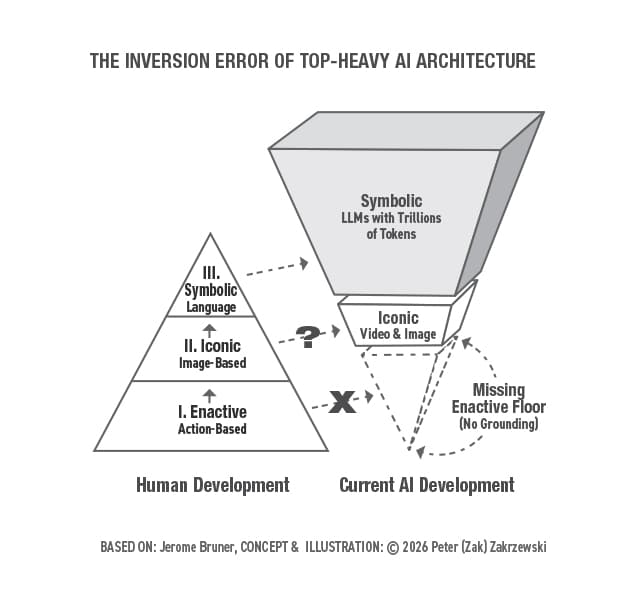
The Inversion Error: Why Safe AGI Requires an Enactive Floor and State-Space Reversibility
Towards Data Science


