
Routing-Free Mixture-of-Experts
arXiv cs.LG / 4/2/2026
📰 NewsSignals & Early TrendsIdeas & Deep AnalysisModels & Research
Key Points
- The paper proposes “Routing-Free Mixture-of-Experts (MoE),” removing centralized routing components (e.g., routers, softmax, top‑k, and load-balancing heuristics) in favor of fully expert-local activation.
- It introduces a unified, adaptive load-balancing framework that optimizes both expert-usage and token-usage objectives via a configurable interpolation for more flexible resource allocation.
- The approach is designed to be trained end-to-end using continuous gradient flow, letting each expert learn its own activation behavior without hard-coded routing biases.
- Experiments report that Routing-Free MoE can outperform existing baselines with improved scalability and robustness, along with a detailed behavioral analysis to guide future MoE design.
- The work aims to inform future MoE design and optimization, potentially impacting how practitioners architect and train expert-based models for efficiency and reliability.
Related Articles

Black Hat Asia
AI Business
v5.5.0
Transformers(HuggingFace)Releases
Bonsai (PrismML's 1 bit version of Qwen3 8B 4B 1.7B) was not an aprils fools joke
Reddit r/LocalLLaMA
Big Tech firms are accelerating AI investments and integration, while regulators and companies focus on safety and responsible adoption.
Dev.to
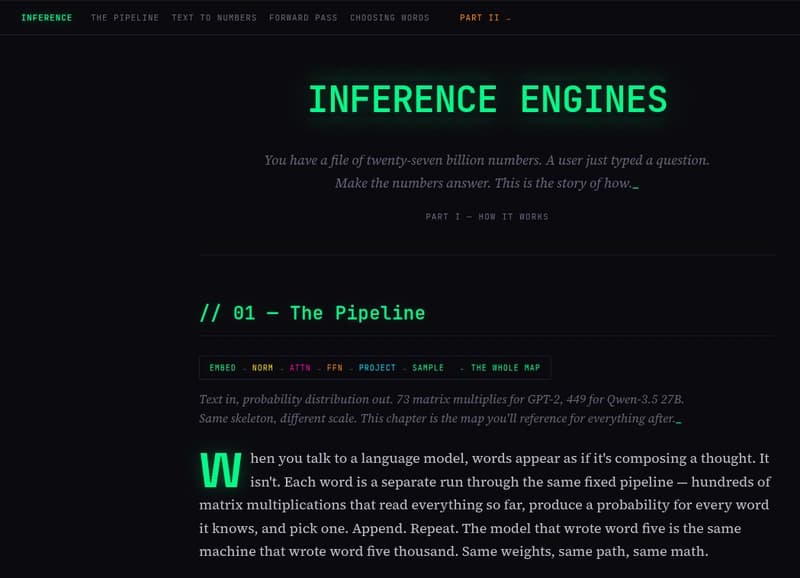
Inference Engines - A visual deep dive into the layers of an LLM
Dev.to


