
From Domain Understanding to Design Readiness: a playbook for GenAI-supported learning in Software Engineering
arXiv cs.AI / 4/2/2026
💬 OpinionIdeas & Deep AnalysisModels & Research
Key Points
- The paper reports a two-week master’s course milestone where 29 students used a customized GPT-3.5 tutor grounded in a curated knowledge base to learn cryptocurrency-finance basics and Domain-Driven Design (DDD).
- An evaluation of 60 prompt–answer pairs found responses were highly accurate (98.9% average accuracy, no factual errors; only 2 minor inaccuracies) and relevant (92.2% average), with strong pedagogical value (89.4%) and generally appropriate cognitive load (82.78%).
- Despite strong content quality, the study found low “supportiveness” (37.78%), indicating that while answers were correct and instructional, the conversational tone and follow-up structure were not as helpful as intended.
- Students showed large gains in self-efficacy from pre to post for genAI-assisted domain learning and applying DDD, suggesting measurable learning impact.
- The authors distill 17 concrete teaching practices for GenAI-supported software engineering education, focusing on prompt/configuration and course workflow design (e.g., expected granularity, limiting verbosity, curated guardrail examples, and lightweight quality rubrics).
💡 Insights using this article
This article is featured in our daily AI news digest — key takeaways and action items at a glance.
Related Articles
v5.5.0
Transformers(HuggingFace)Releases
Bonsai (PrismML's 1 bit version of Qwen3 8B 4B 1.7B) was not an aprils fools joke
Reddit r/LocalLLaMA

Big Tech firms are accelerating AI investments and integration, while regulators and companies focus on safety and responsible adoption.
Dev.to
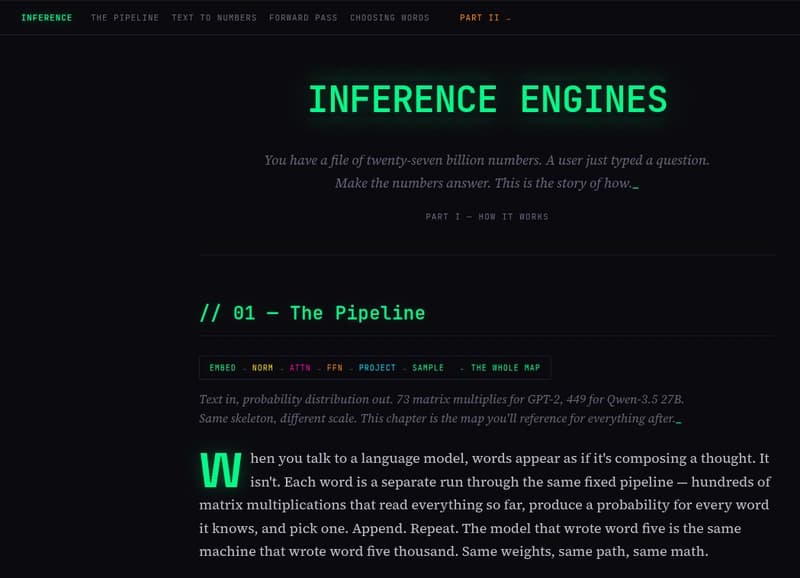
Inference Engines - A visual deep dive into the layers of an LLM
Dev.to
Surprised by how capable Qwen3.5 9B is in agentic flows (CodeMode)
Reddit r/LocalLLaMA


