Humanoid robots one tiny step closer to exterminating autoworkers' jobs
Torso on a trolley tries its hands in warehouse role


That's one small step for Humanoid, or rather a short factory floor traversal. The UK-based robotics biz says it has completed a proof-of-concept test showing its rolling robot can be deployed in a production environment to help with automotive manufacturing.
Humanoid worked with SAP and automotive parts supplier Martur Fompak to demonstrate that its HMND 01 Alpha Wheeled robot – a torso with arms mounted on a wheeled platform – is fit for warehouse work.
The robot was set up to handle a logistics picking workflow. The task involved receiving instructions from the SAP AI agent, navigating across the work area to the selected pallet, fetching the appropriate KLT box, and putting it on a trolley. The company claims that repeating the task as part of the order-fulfillment flow shows the bot is fit for purpose.
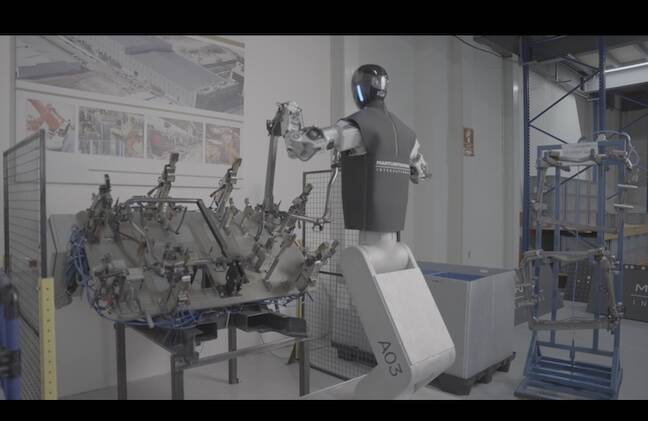
HMND 01 Alpha Wheeled robot
During this test, the robot relied on Humanoid's KinetIQ stack, which is designed to orchestrate multiple robots, and SAP Business AI.
The Humanoid robot was linked to SAP's API using the SAP Joule agent layer. This enabled the robot to receive tasks over the internet from the SAP Extended Warehouse Management system.
The test ran from January to February, encompassing the development of the robot, in-house testing, site preparation, and deployment. Those involved say that the robot performed well and demonstrated that it could handle three different tote types within an 8 kg dual-arm payload limit.
Dr Lukasz Ostrowski, who runs SAP SE's embodied AI and robotics group, described the project as a shift in the way robots can address business needs.
"This proof of concept in the manufacturing industry allows us to demonstrate how humanoid robots can act as extensions of an organization's operations by providing business context awareness and integration with existing workflows," he said in a statement.
- AI bug reports went from junk to legit overnight, says Linux kernel czar
- Anthropic tweaks timed usage limits to discourage Claude demand during peak hours
- Using AI to code does not mean your code is more secure
- GitHub hits CTRL-Z, decides it will train its AI with user data after all
Artem Sokolov, founder and CEO of Humanoid, hailed the test as a demonstration that humanoid robots can operate in production environments while connected to real enterprise systems.
"That's the bridge between experimentation and deployment," he said.
It's a bridge that may be longer than it appears. Last year, when the International Federation of Robotics (IFR) looked at the state of humanoid robots, the organization concluded that various obstacles remain before humanoid forms become more practical than traditional industrial robots.
One such barrier is cost. In its position paper [PDF], "Humanoid Robots: Vision and Reality," the IFR said that the high cost of materials and components and the complexity of design and programming "renders [humanoid robots] unaffordable for cost-effective operations."
There will be more of them over the next five to ten years, but economies of scale will need to improve – not to mention safety, battery life, and dexterity – before humanoid robots become practical.
"Humanoids are not expected to replace the types of robots currently on the market," the IFR said. "Instead, they will complement and expand upon existing technology, such as industrial robots and AMRs [autonomous mobile robots], while also introducing new ways of programming robots." ®
More about
More about
Narrower topics
- AdBlock Plus
- AIOps
- App
- Application Delivery Controller
- Audacity
- Confluence
- Database
- DeepSeek
- FOSDEM
- FOSS
- Gemini
- Google AI
- GPT-3
- GPT-4
- Grab
- Graphics Interchange Format
- IDE
- Image compression
- Jenkins
- Large Language Model
- Legacy Technology
- LibreOffice
- Machine Learning
- Map
- MCubed
- Microsoft 365
- Microsoft Office
- Microsoft Teams
- Mobile Device Management
- Neural Networks
- NLP
- OpenOffice
- Programming Language
- QR code
- Retrieval Augmented Generation
- Retro computing
- Rimini Street
- Search Engine
- Software Bill of Materials
- Software bug
- Software License
- Star Wars
- Tensor Processing Unit
- Text Editor
- TOPS
- User interface
- Visual Studio
- Visual Studio Code
- WebAssembly
- Web Browser
- WordPress
Broader topics
More about
More about
More about
Narrower topics
- AdBlock Plus
- AIOps
- App
- Application Delivery Controller
- Audacity
- Confluence
- Database
- DeepSeek
- FOSDEM
- FOSS
- Gemini
- Google AI
- GPT-3
- GPT-4
- Grab
- Graphics Interchange Format
- IDE
- Image compression
- Jenkins
- Large Language Model
- Legacy Technology
- LibreOffice
- Machine Learning
- Map
- MCubed
- Microsoft 365
- Microsoft Office
- Microsoft Teams
- Mobile Device Management
- Neural Networks
- NLP
- OpenOffice
- Programming Language
- QR code
- Retrieval Augmented Generation
- Retro computing
- Rimini Street
- Search Engine
- Software Bill of Materials
- Software bug
- Software License
- Star Wars
- Tensor Processing Unit
- Text Editor
- TOPS
- User interface
- Visual Studio
- Visual Studio Code
- WebAssembly
- Web Browser
- WordPress